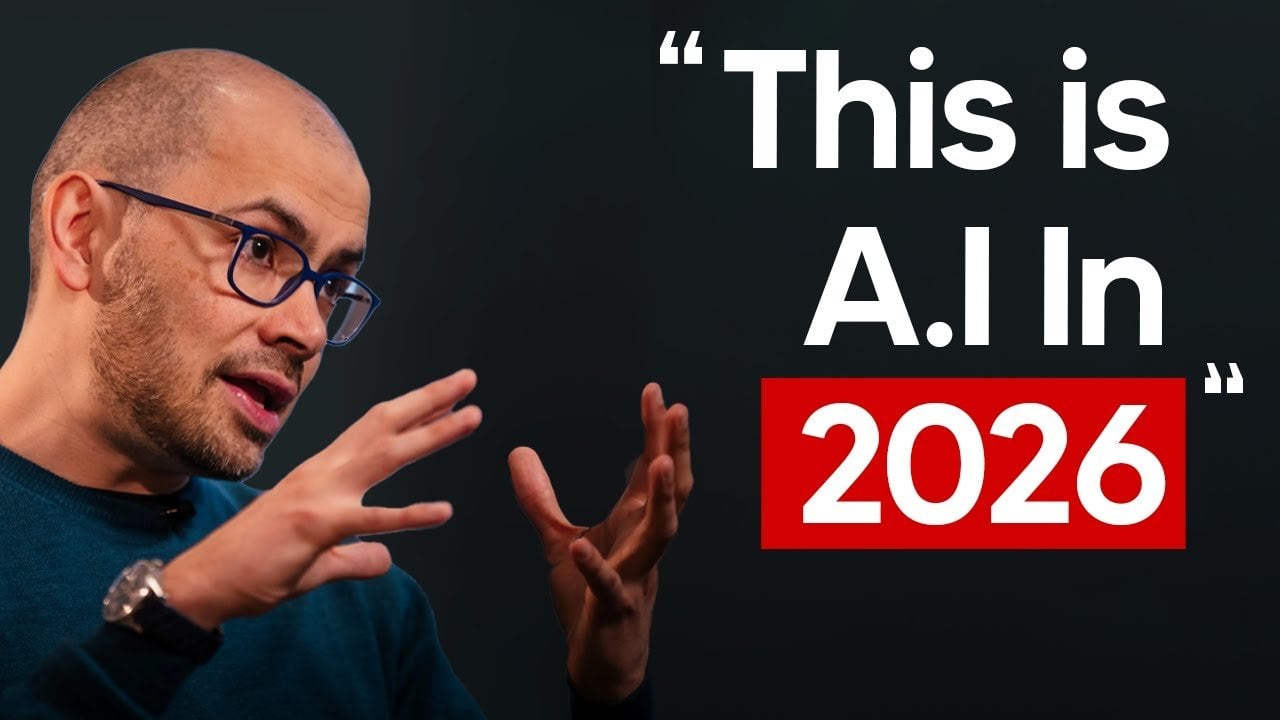
How Google Sees 2026 AI : From Unified Models to Co-Scientist & Code Men Agents
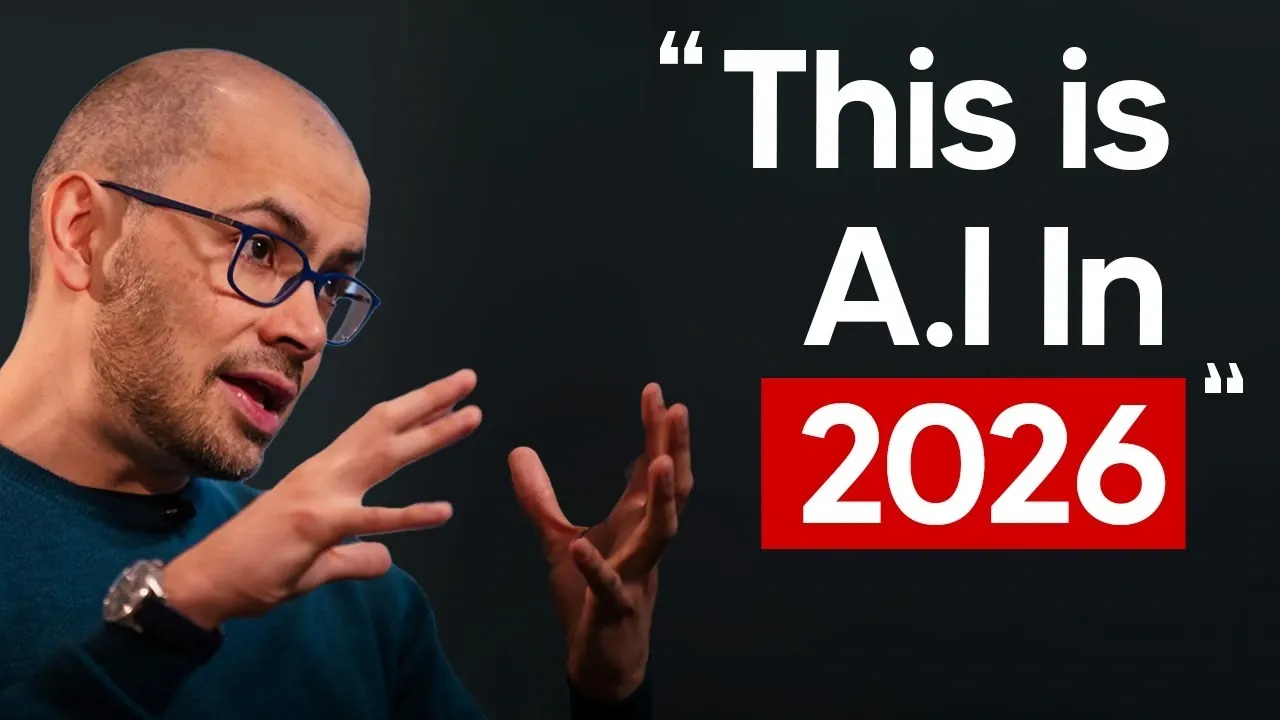
What if you could hold a conversation with an AI that not only understands your words but also interprets the emotions in your voice, the context of your surroundings, and even the visuals in your environment, all at once? By 2026, this vision may not just be science fiction but an everyday reality. According to Google’s AI chief, Demis Hassabis, the next wave of artificial intelligence will transcend today’s capabilities, evolving into systems that seamlessly integrate across text, images, video, audio, and even robotics. These “full omnimodels” promise to bring AI closer to human-like reasoning, allowing breakthroughs in fields as diverse as disaster response, creative industries, and scientific discovery. But what does this mean for how we live, work, and solve problems? The implications are as thrilling as they are fantastic.
This overview AI Grid provides more insights into the innovative potential of technologies like Google’s Gemini platform, which is at the forefront of this AI evolution. From real-time AI assistants that guide users through intricate tasks to agent-based systems accelerating cybersecurity and scientific innovation, the possibilities are vast. You’ll discover how AI is poised to reshape industries, tackle global challenges, and redefine creativity. But as we stand on the cusp of this new era, questions about the ethical and societal impacts of such advancements loom large. What will it mean to coexist with machines capable of reasoning and decision-making at this scale? Let’s explore the future of AI and the profound ways it could reshape our world.
AI Advancements by 2026
TL;DR Key Takeaways :
- By 2026, AI is expected to achieve unprecedented integration across multiple modalities, including text, images, video, audio, robotics, and 3D environments, powered by Google’s Gemini platform.
- Google’s “full omnimodels” represent a major leap in AI, allowing systems to process and reason across diverse data types simultaneously, enhancing human-like reasoning and real-world applications.
- The Gemini platform includes specialized components like Gemini Robotics 1.5, Nano Banana Pro, V3 Video Model, and Gemini Live, designed to improve AI’s adaptability and impact across industries.
- AI-powered virtual environments and agent-based systems, such as Co-Scientist Agent and Code Men Agent, are driving advancements in disaster preparedness, scientific discovery, and cybersecurity.
- Real-time AI assistance and creative tools, like Gemini Live and V3 Video Model, are transforming productivity, content creation, and innovation in industries such as entertainment, education, and marketing.
Full Omnimodels: A Unified Approach to AI
The concept of “full omnimodels” represents a significant leap forward in AI technology. These systems are designed to process and reason across multiple data types simultaneously, allowing them to perform complex, context-driven tasks with remarkable efficiency. For example, a full omnimodel could analyze a video, extract key textual information, and generate a concise summary, all within a single, unified framework.
By integrating diverse data sources, full omnimodels enhance AI’s ability to understand relationships and context, making them more versatile and effective in real-world applications. This capability brings AI closer to human-like reasoning, allowing it to tackle challenges that require a nuanced understanding of complex, interconnected information.
The Role of Google’s Gemini Platform
At the heart of these advancements lies Google’s Gemini platform, a innovative AI ecosystem designed to push the boundaries of what AI can achieve. The platform is composed of several specialized components, each addressing specific challenges and expanding AI’s capabilities:
- Gemini Robotics 1.5: Enables robots to execute multi-step tasks with precision, improving their adaptability to real-world scenarios.
- Nano Banana Pro: An advanced image model that incorporates agent-like reasoning for accurate visual analysis and decision-making.
- V3 Video Model: A leader in video-to-image and multimodal video generation, opening new possibilities for content creation and analytical applications.
- Gemini Live: A real-time AI assistant designed to guide users through intricate processes, from troubleshooting technical issues to enhancing creative workflows.
These components collectively aim to make AI more practical, adaptable, and impactful across industries, from manufacturing and healthcare to entertainment and education.
Googles AI Boss Reveals What AI in 2026 Will Look Like
Here are more detailed guides and articles that you may find helpful on humanoid robots.
- Neo Humanoid Robot: Overhyped AI or Game-Changer?
- New OpenAI ChatGPT-5 humanoid robot unveiled 1X NEO Beta
- Most Advanced Humanoid Robot Ever Created
- Atlas Humanoid Robot : Transforming Manufacturing and More
- $1,000 Kscale Labs Humanoid Robot : The Future of Affordable
- Astribot S1 AI Humanoid robot unveiled
- How the Optimus Tesla Bot humanoid robot is made
- H1 Humanoid Robot sets new world record for running
- Figure 03 Humanoid Robot: A New Era of AI-Powered Companions
- Boston Dynamics Atlas Humanoid Robot Incredible Moves
Interactive Virtual Environments
AI-powered virtual environments are becoming increasingly sophisticated, offering innovative ways to simulate and interact with complex systems. Google’s World Models (Genie 3) exemplify this trend, featuring advanced memory and reasoning capabilities that enable more intelligent and dynamic interactions.
These environments are not limited to gaming. They are being used for disaster preparedness simulations, training programs, and scientific research. For instance, an AI-driven simulation could model natural disasters, allowing researchers and policymakers to test response strategies in real-time. This capability has the potential to improve decision-making in high-stakes scenarios, ultimately saving lives and resources.
Specialized Agent-Based Systems
Agent-based systems are a cornerstone of Google’s AI strategy, offering targeted solutions to specific challenges across various domains. These specialized AI agents are designed to complement human expertise, streamlining workflows and allowing breakthroughs in science, security, and data analysis. Key examples include:
- Co-Scientist Agent: Assists researchers by generating hypotheses, designing experiments, and analyzing results, accelerating the pace of scientific discovery.
- Code Men Agent: Focuses on cybersecurity, identifying and resolving vulnerabilities in codebases to enhance software reliability and security.
- Data Science Agent: Automates data analysis workflows, including data cleaning, visualization, and modeling, making data-driven insights more accessible.
- Alpha Evolve: Accelerates the discovery of scientific algorithms and solutions through AI-driven coding, fostering innovation in computational research.
These agents are designed to handle specialized tasks with precision, allowing professionals to focus on higher-level decision-making and creative problem-solving.
Real-Time Assistance and Creative Applications
Real-time AI assistance is becoming increasingly practical and accessible, thanks to tools like Gemini Live. Whether you’re assembling complex machinery, navigating a software platform, or troubleshooting technical issues, these systems provide step-by-step guidance to simplify intricate tasks. This capability not only enhances productivity but also reduces the learning curve for complex processes.
In the realm of creativity, advancements in video-to-image and multimodal video generation, spearheaded by the V3 Video Model, are unlocking new possibilities. From producing high-quality visual content to conducting technical analyses, these tools are reshaping how individuals and organizations interact with visual media. The ability to generate and manipulate content with precision is opening doors for innovation in industries such as entertainment, marketing, and education.
AI’s Role in Scientific Discovery and Cybersecurity
AI is playing a pivotal role in advancing scientific discovery and cybersecurity, two critical areas for global progress. Tools like the Co-Scientist Agent are allowing researchers to explore uncharted territories by automating hypothesis generation, experiment design, and data analysis. This accelerates the pace of innovation, allowing scientists to focus on interpreting results and refining theories.
In parallel, the Code Men Agent is transforming cybersecurity by proactively identifying and fixing vulnerabilities in software systems. This approach ensures that critical infrastructure remains robust and secure, addressing one of the most pressing challenges in today’s increasingly digital world. By enhancing both scientific research and cybersecurity, AI is contributing to a safer and more innovative future.
What the Future Holds
The integration of multimodal AI, robotics, and virtual environments is expected to accelerate in the coming years, driving significant advancements across industries. Agent-based systems will continue to evolve, offering specialized solutions for science, security, and data analysis. These developments have the potential to transform industries, foster scientific breakthroughs, and address real-world challenges with unprecedented efficiency.
By 2026, AI will not only be more capable but also more deeply embedded in everyday life. From assisting in complex tasks to advancing scientific research, AI is poised to become an indispensable partner in human progress. Google’s Gemini platform is leading the charge, setting the stage for a future where AI reshapes how we work, learn, and solve problems, ultimately enhancing the way we live and interact with the world.
Media Credit: TheAIGRID
Filed Under: AI, Technology News, Top News
Latest Geeky Gadgets Deals
Disclosure: Some of our articles include affiliate links. If you buy something through one of these links, Geeky Gadgets may earn an affiliate commission. Learn about our Disclosure Policy.