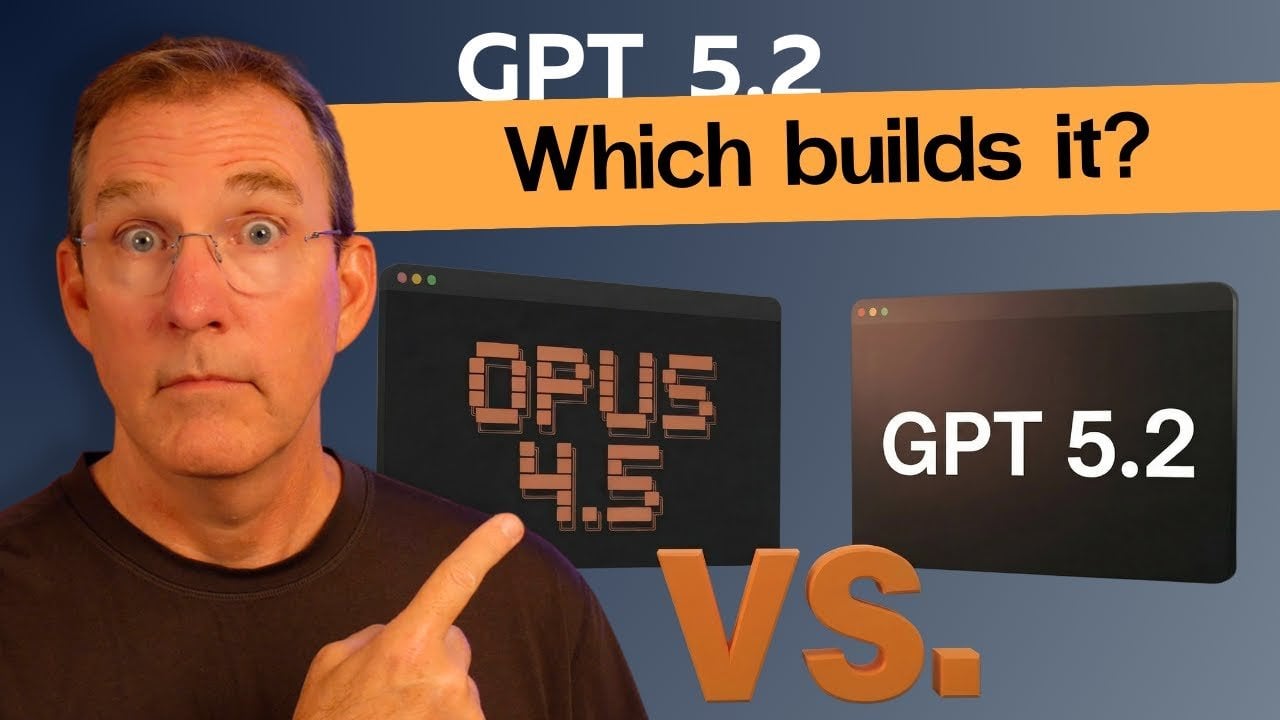
GPT-5.2 vs Opus 4.5 : Head to Head AI Coding Showdown
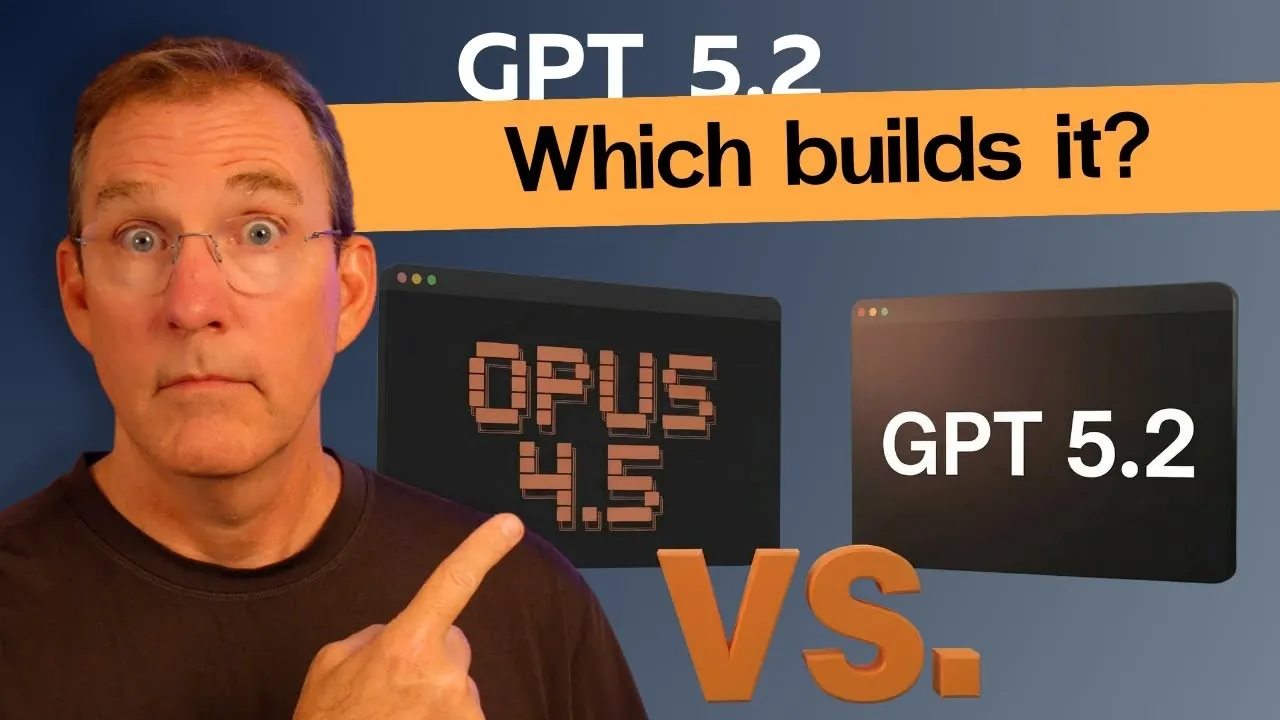
What if the future of coding wasn’t just about human ingenuity but also about how well AI could collaborate with us? In the race to redefine software development, two titans, OpenAI’s GPT-5.2 and Anthropic’s Opus 4.5—have emerged as frontrunners. Both models promise to transform the way we build applications, but their approaches couldn’t be more different. One features raw speed and technical prowess, while the other prioritizes precision and seamless communication. But here’s the catch: neither has yet mastered the art of full autonomy. This breakdown pits them head-to-head in a rigorous coding benchmark, revealing not just their strengths but also the critical gaps that still tether them to human intervention.
Through this comparison by Matt Maher, you’ll uncover how these models tackle the complexities of real-world software development, from interpreting dense technical documentation to implementing nuanced features like dynamic seasonal themes. Which model excels in collaborative workflows? Where do they falter when faced with intricate Product Requirements Documents (PRDs)? And most importantly, what do these findings mean for the future of AI-driven coding? By the end, you’ll have a clearer picture of how these tools stack up, and what it will take for them to truly transform the software development landscape. The question isn’t just which model is better, but whether either is ready to meet the demands of tomorrow’s developers.
AI Coding Benchmark Insights
TL;DR Key Takeaways :
- GPT-5.2 and Opus 4.5 were evaluated on their ability to autonomously develop a complex application based on a detailed Product Requirements Document (PRD), revealing strengths and limitations in real-world coding scenarios.
- Opus 4.5 excelled in feature completeness and communication, providing detailed feedback and adhering closely to design specifications, making it more effective in collaborative workflows.
- GPT-5.2 demonstrated faster execution speed and scalability but struggled with feedback transparency, limiting its usability in iterative and collaborative development processes.
- Neither model achieved full implementation of the PRD autonomously, highlighting the need for user intervention and iterative refinement to address gaps in feature completeness.
- Future improvements, such as enhanced feedback mechanisms and self-evaluation systems, are critical for advancing AI coding models and unlocking their full potential in automating complex software development tasks.
Design and Structure of the Benchmark
The benchmark was carefully crafted to assess the models’ ability to interpret and execute complex instructions. A comprehensive PRD served as the foundation for this evaluation, detailing the technical and design requirements of a functional application. The PRD included several key components:
- Parsing and interpreting technical documentation to understand the application’s architecture and dependencies.
- Adhering to user interface (UI) and user experience (UX) design specifications to ensure usability and aesthetic consistency.
- Implementing advanced features, such as dynamic seasonal themes and inline media trailers, to test the models’ ability to handle nuanced requirements.
The evaluation criteria focused on three primary aspects: feature completeness, clarity of communication, and iterative refinement during the development process. These criteria were chosen to reflect the challenges developers face when working on complex projects, emphasizing both technical execution and collaborative potential.
Performance Analysis: Strengths and Limitations
GPT-5.2: Speed and Scalability with Communication Challenges
GPT-5.2, an enhanced iteration of its predecessor GPT-5.1, demonstrated significant improvements in execution speed and technical comprehension. It was tested across varying levels of complexity, medium, high, and extra high, and consistently showcased its ability to process and implement intricate coding tasks. However, despite its speed and scalability, GPT-5.2 fell short in achieving full feature completeness. Several critical elements outlined in the PRD remained unimplemented, highlighting gaps in its ability to deliver a fully functional application.
A notable limitation of GPT-5.2 was its lack of communication clarity. The model provided minimal feedback during the development process, making it difficult for users to track progress or pinpoint areas requiring adjustment. This lack of transparency posed challenges in collaborative workflows, where clear and consistent communication is essential for iterative refinement and problem-solving.
Opus 4.5: Precision and Enhanced Communication
Anthropic’s Opus 4.5 excelled in several critical areas, particularly in feature completeness. The model successfully implemented nuanced features, such as dynamic seasonal themes and inline media trailers, demonstrating a strong ability to adhere to the PRD’s design and technical specifications. Its outputs were consistently aligned with the requirements, showcasing a higher degree of precision compared to GPT-5.2.
Opus 4.5’s standout feature was its communication capability. The model provided detailed feedback throughout the development process, including progress updates, to-do lists, and actionable suggestions. This transparency not only enhanced user confidence but also assistd iterative refinement, making it easier to identify and address gaps in implementation. These qualities positioned Opus 4.5 as a more effective tool for collaborative workflows, where user interaction and feedback play a pivotal role.
GPT-5.2 vs Opus 4.5 : The Ultimate Coding Benchmark
Here is a selection of other guides from our extensive library of content you may find of interest on AI coding.
- SpecKit Review: GitHub’s New Tool for Reliable AI Coding
- ChatGPT 5 vs Claude Sonnet: Real-World AI Coding Comparison
- Codex vs Claude Code: A Detailed Comparison of AI Coding CLIs
- Save Money on AI Coding: Use Free Extensions In VS Code
- Gemini Coder 2 Build Mode : Free AI Coding Tool You Need to Try
- ChatGPT 5 vs Claude Opus 4.1: AI Coding Assistant Comparison
- Gemini 3 Free AI Coding Agent : Google AI Studio Build Mode
- New Claude Code 2.0 Agentic AI Coding Agent : The Secret
- Sonnet 4.5 vs GLM 4.6 vs Codex : Detailed AI Coding Comparison
- How the Claude SANDBOX Method Makes AI Coding 90% Faster
Comparative Strengths and Weaknesses
Both GPT-5.2 and Opus 4.5 demonstrated impressive capabilities, but their performance also revealed distinct strengths and weaknesses:
- Strengths: Both models effectively parsed technical documentation and tackled complex coding tasks with minimal guidance. Their ability to iteratively refine outputs allowed for gradual improvements in feature implementation.
- Weaknesses: GPT-5.2’s limited feedback transparency hindered its usability in collaborative settings, while Opus 4.5, despite its superior communication and precision, still required significant user intervention to achieve full feature completeness.
These findings underscore the importance of structured PRDs and effective prompt engineering in maximizing the performance of AI coding models. Communication style emerged as a critical differentiator, with Opus 4.5 offering a more user-friendly experience, particularly in scenarios requiring iterative collaboration.
Key Insights from the Benchmark
The coding benchmark provided several valuable insights into the evolving capabilities of AI models in software development:
- Neither GPT-5.2 nor Opus 4.5 could autonomously implement the PRD in its entirety, but both demonstrated the potential to come close with iterative adjustments and user intervention.
- Opus 4.5’s superior communication and adherence to design specifications made it more effective in collaborative workflows, where user feedback and interaction are critical.
- GPT-5.2’s faster execution speed could be advantageous in time-sensitive scenarios, provided its feedback mechanisms are improved to enhance usability and transparency.
These results highlight the progress made in AI-driven coding while emphasizing the challenges that remain in achieving full autonomy. The ability to balance speed, precision, and communication will be key to unlocking the full potential of these models.
Future Development Opportunities
The benchmark results point to several areas for improvement and future development in AI coding models:
- Enhanced Feedback Mechanisms: Improving the transparency and clarity of feedback in models like GPT-5.2 could significantly enhance their usability, particularly in collaborative workflows.
- Self-Evaluation Systems: Developing systems that enable models to autonomously identify and address implementation gaps will be critical for advancing their capabilities and reducing reliance on user intervention.
- Accelerated Development Processes: As AI models continue to evolve, their ability to accelerate complex application development with minimal human input could transform the software development landscape.
The rapid progress in AI coding capabilities suggests a future where these technologies play an increasingly central role in automating complex tasks. By addressing current limitations and focusing on iterative refinement, models like GPT-5.2 and Opus 4.5 could become indispensable tools for developers, streamlining workflows and enhancing productivity.
Broader Implications for AI in Software Development
The performance of GPT-5.2 and Opus 4.5 in this benchmark reflects the growing potential of AI to transform software development. While neither model achieved full autonomy, their ability to interpret complex PRDs, implement advanced features, and refine outputs through iteration highlights their value as collaborative tools. Addressing current challenges, such as feedback transparency and self-evaluation, will be essential for unlocking their full potential.
As these technologies continue to mature, their applications are likely to expand beyond coding, influencing areas such as project management, design optimization, and quality assurance. For now, GPT-5.2 and Opus 4.5 represent a significant step forward in the integration of AI into software development, offering a glimpse into a future where AI-driven tools play a central role in shaping the digital landscape.
Media Credit: Matt Maher
Filed Under: AI, Technology News, Top News
Latest Geeky Gadgets Deals
Disclosure: Some of our articles include affiliate links. If you buy something through one of these links, Geeky Gadgets may earn an affiliate commission. Learn about our Disclosure Policy.