
$40K Apple Mac Studio RDMA Setup: 1 TFLOP per Node, 3.7 TFLOPS Across Four

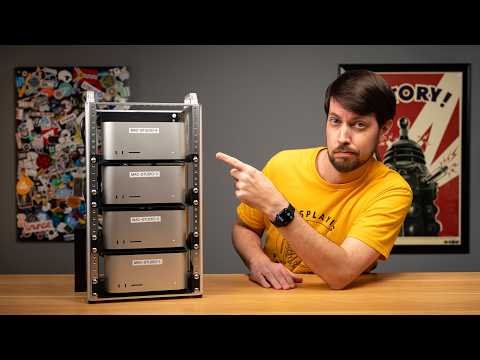
What happens when a company known for sleek design and user-friendly tech decides to tackle the world of high-performance computing? Apple’s latest move with macOS 26.2 and its integration of RDMA over Thunderbolt is nothing short of audacious. In a recent video, Jeff Geerling breaks down how this feature, tested on a four-node Mac Studio cluster, pushes the boundaries of local AI workflows and memory pooling efficiency. The results? An impressive 3.7 teraflops of performance, all while maintaining Apple’s signature energy efficiency. But as new as this sounds, it raises an important question: is Apple’s proprietary approach a bold innovation or a limiting factor for broader adoption?
In this breakdown, we’ll explore what makes RDMA over Thunderbolt such a fantastic option for AI developers and creative professionals, while also unpacking the challenges that come with it. From the M3 Ultra chip’s staggering performance to the scalability roadblocks imposed by Thunderbolt’s design, there’s plenty to uncover. Whether you’re intrigued by the idea of pooling memory across multiple Macs or curious about how Apple stacks up against industry giants like Nvidia, this guide will give you a closer look at the trade-offs shaping the future of local high-performance computing. It’s a story of innovation, but one that leaves us wondering: how far can Apple really take this?
Apple’s RDMA Over Thunderbolt
TL;DR Key Takeaways :
- Apple’s macOS 26.2 introduces RDMA over Thunderbolt, allowing seamless memory pooling and significant performance gains for local AI and HPC workflows, achieving up to 3.7 teraflops in a four-node Mac Studio cluster.
- The Mac Studio, powered by the M3 Ultra chip, delivers exceptional performance and energy efficiency, handling AI models with up to 1 trillion parameters while consuming less than 250 watts per node.
- Scalability is limited due to Thunderbolt’s port constraints, restricting clusters to four Macs, and the absence of advanced networking options like 100-gigabit Ethernet hinders enterprise-level applications.
- macOS 26.2 faces challenges in cluster management, with less intuitive tools compared to Linux systems, highlighting the need for improved automation and user-friendly solutions.
- Exo, the open source tool used for testing, simplifies clustering workflows but faces concerns about long-term support and compatibility with other hardware platforms, underscoring the importance of ongoing development.
Transforming Local AI and HPC
The introduction of RDMA over Thunderbolt in macOS 26.2 marks a significant leap forward for local AI and HPC workflows. This feature allows Mac Studio systems to pool memory seamlessly, allowing faster and more efficient AI model processing. Tested with Exo, a four-node Mac Studio cluster achieved an impressive 3.7 teraflops, outperforming similarly priced systems in both efficiency and memory capacity. Compared to traditional tools like Llama.cpp, RDMA over Thunderbolt delivers substantial performance gains, making it a fantastic option for developers working on resource-intensive tasks.
However, scalability remains a notable limitation. Thunderbolt’s inherent port constraints restrict clustering to a maximum of four Macs, making it less suitable for large-scale workloads or enterprise-level deployments. While Thunderbolt 5 offers incremental improvements, its bandwidth and latency limitations underscore the need for alternative networking solutions to support broader scalability.
Performance and Energy Efficiency: A Competitive Edge
At the heart of the Mac Studio is the M3 Ultra chip, which delivers exceptional performance while maintaining energy efficiency. A single node surpasses the 1 teraflop threshold, and a four-node cluster can handle AI models with up to 1 trillion parameters. This level of performance positions the Mac Studio as a strong competitor against systems like the Nvidia DGX Spark and AMD AI Max Plus 395.
The Mac Studio’s energy efficiency is another standout feature. Consuming less than 250 watts per node, it offers a significant advantage over competing systems, which often require substantially higher power levels. These attributes make the Mac Studio particularly appealing to AI developers and creative professionals tackling demanding computational tasks. However, the high cost of the hardware may deter broader adoption, especially in budget-conscious environments.
Apple didn’t have to go this hard…
Learn more about Apple Mac systems by reading our previous articles, guides and features :
- Apple Mac Mini M5: Release Date, Specs, and Pricing Details
- New Apple Mac Studio with M2 Ultra and M2 Max
- Apple Mac Studio computer with M1 Ultra chip
- Why the M5 Mac mini is a Game-Changer for Apple
- Apple Mac Pro 2013 Recreated As 3D Printed Model
- Apple Mac Split View screen feature explained
- Apple Mac enamel pin set
- New Apple Mac Pro with Apple Silicon in the works
- Apple Mac Pro Teaser Video Posted On YouTube (video)
- Apple Modular SSDs in M4 Pro Mac Mini: What It Means for Macs
Design and Practical Trade-Offs
Apple’s renowned design philosophy is evident in the Mac Studio’s compact, quiet, and energy-efficient build. The inclusion of an internal power supply simplifies setup, reducing the need for external components. However, the reliance on proprietary power and Thunderbolt cables introduces logistical challenges, particularly for users managing multiple systems.
The absence of advanced networking options, such as QSFP or 100-gigabit Ethernet, limits the Mac Studio’s scalability and durability for enterprise-level applications. While Thunderbolt 5 offers some improvements in bandwidth, it still falls short of the requirements for larger clusters. These limitations highlight the need for Apple to explore alternative networking solutions to enhance the system’s versatility and appeal to a broader audience.
Cluster Management: Challenges and Opportunities
Despite its hardware advancements, macOS 26.2 reveals gaps in cluster management capabilities. Tasks such as system-wide upgrades via SSH are less intuitive compared to Linux-based systems, requiring additional automation to streamline workflows. During testing, pre-release software bugs further complicated the process, emphasizing the need for more robust and user-friendly management tools.
These shortcomings may deter users accustomed to the flexibility and reliability of Linux environments, which dominate the HPC landscape. Addressing these challenges will be crucial for Apple to position macOS as a viable alternative for high-performance computing clusters.
Exo: Open source Collaboration in Action
Exo, the open source tool used to test RDMA functionality, plays a pivotal role in simplifying clustering workflows. Released under the Apache 2.0 license, Exo adheres to open source principles, fostering trust and transparency among developers. Its ability to streamline memory pooling and cluster management highlights the potential of open source collaboration in advancing HPC technologies.
However, concerns about Exo’s long-term support have emerged due to periods of developer inactivity. Expanding its compatibility with other hardware platforms, such as Nvidia DGX Spark, could enhance its utility and broaden its appeal. Future updates that address these concerns will be critical for maintaining Exo’s relevance in the rapidly evolving HPC landscape.
Looking Ahead: Opportunities for Growth
Apple’s advancements in macOS 26.2 and the Mac Studio highlight the company’s commitment to innovation in AI and HPC. However, addressing current limitations will be essential for broader adoption. Potential future developments could include the introduction of an M5 Ultra chip or a revamped Mac Pro with PCIe expansion, allowing greater flexibility and scalability.
Expanding RDMA support to applications such as video editing, real-time rendering, or scientific simulations could further enhance the Mac Studio’s appeal to creative professionals and researchers. Additionally, integrating alternative networking solutions, such as 100-gigabit Ethernet, may be necessary to overcome the inherent limitations of Thunderbolt 5 and support larger clusters.
While the Mac Studio excels in AI development and creative tasks, its high cost and limited scalability confine its appeal to niche markets. Nevertheless, its versatility ensures it remains a valuable tool even beyond the current AI boom, reinforcing Apple’s position as a leader in high-performance computing.
Media Credit: Jeff Geerling
Filed Under: AI, Apple, Hardware
Latest Geeky Gadgets Deals
Disclosure: Some of our articles include affiliate links. If you buy something through one of these links, Geeky Gadgets may earn an affiliate commission. Learn about our Disclosure Policy.