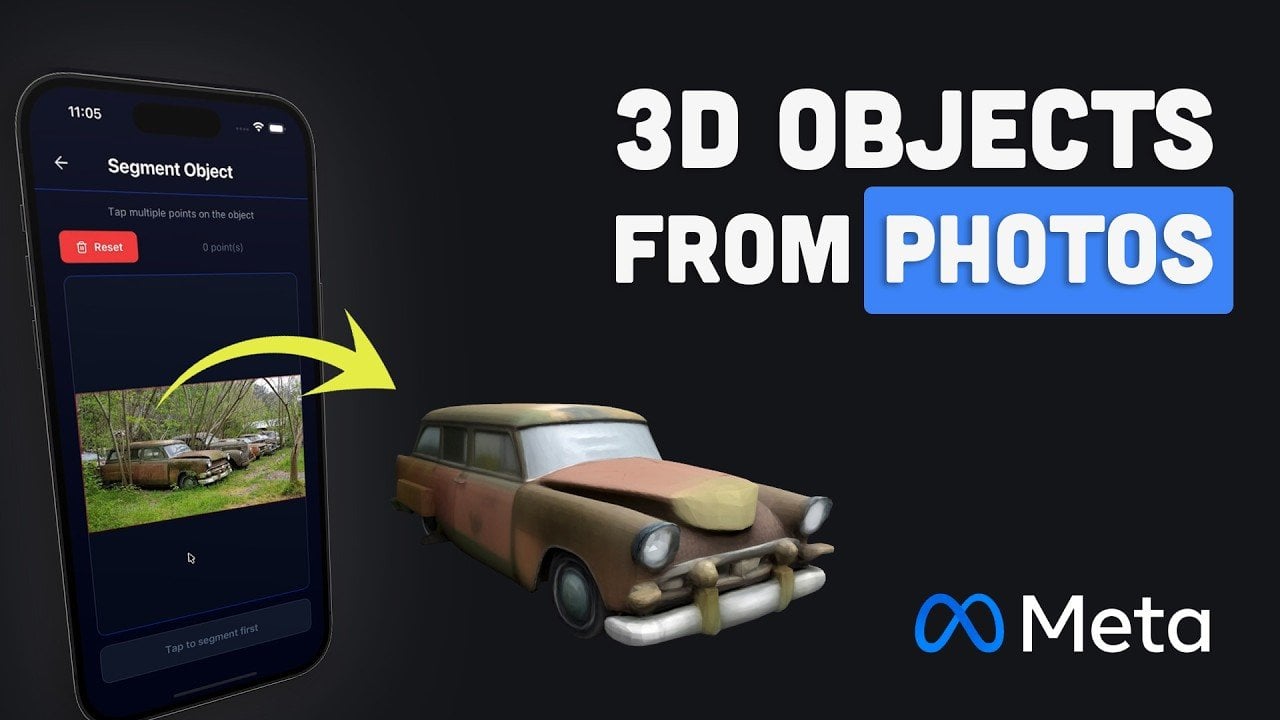
Turn Any Photo into a 3D Model with SAM 3D : From One Snapshot to Shareable Mesh
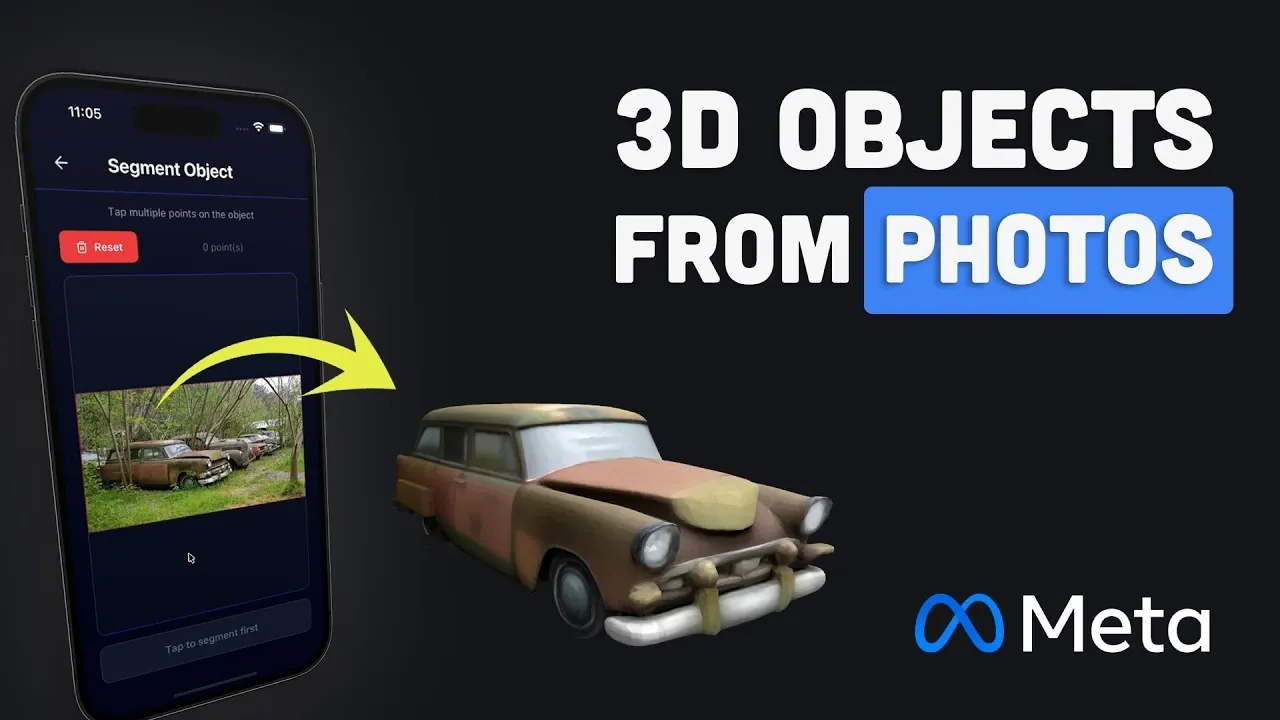
Imagine snapping a photo of your favorite object, a vintage car, a family heirloom, or even your pet, and instantly transforming it into a lifelike 3D model. Thanks to Meta’s SAM 3D, this futuristic concept is now a reality. In the video, Better Stack breaks down how this new AI uses advanced techniques like image segmentation and depth analysis to create highly detailed 3D reconstructions from simple 2D images. Whether you’re a designer crafting virtual worlds or a hobbyist experimenting with 3D printing, SAM 3D opens up a world of possibilities by bridging the gap between flat photos and immersive, interactive models. It’s not just a technical leap; it’s a glimpse into how AI is reshaping creativity.
In this overview, you’ll discover how SAM 3D works its magic, from isolating objects in an image to generating realistic 3D meshes with textures and depth. You’ll also learn about its specialized variants, including one tailored for human body modeling, and explore the practical applications of this technology in fields like gaming, architecture, and virtual reality. But it’s not all smooth sailing, SAM 3D has its quirks and limitations, especially when it comes to intricate patterns or hardware demands. Still, the potential is undeniable. Could this be the next big step in making 3D modeling accessible to everyone?
Meta’s SAM 3D Overview
TL;DR Key Takeaways :
- Meta’s SAM 3D technology converts 2D images into detailed 3D objects using advanced AI techniques like segmentation, depth inference, and geometry mapping.
- SAM 3D offers two specialized variants: SAM 3D Objects for general use cases and SAM 3D Body for human shapes and poses, catering to diverse applications such as gaming, VR, and architecture.
- The workflow involves vision encoding, depth and geometry analysis, and 3D point cloud generation, allowing accurate reconstructions even for partially obscured objects.
- The SAM 3D mobile app simplifies the process with features like photo capture, segmentation, and real-time 3D visualization, while its open source codebase encourages customization and innovation.
- Despite challenges like dependency on high-quality input images and powerful GPUs, SAM 3D excels in versatility, realistic outputs, and handling occlusions, making it a valuable tool across industries.
Meta’s SAM models are built to isolate and segment objects in images with exceptional precision. The original SAM model focuses on generating pixel-perfect masks for objects within 2D images, serving as the foundation for SAM 3D. Expanding on this, SAM 3D reconstructs 3D shapes from segmented images by analyzing depth, geometry, and texture to produce realistic 3D meshes. This progression highlights the adaptability and scalability of SAM technology.
SAM 3D is available in two specialized variants:
- SAM 3D Objects: Optimized for general objects and diverse environments, making it suitable for a broad range of use cases.
- SAM 3D Body: Specifically tailored for human body shapes and poses, offering enhanced accuracy in applications like animation and virtual avatars.
These models are versatile and adaptable, making them ideal for applications ranging from gaming and virtual reality to architectural visualization and beyond. Their ability to handle diverse scenarios ensures that users can explore a wide array of creative and technical possibilities.
How SAM 3D Works
The process behind SAM 3D is both sophisticated and efficient, combining multiple AI-driven techniques to achieve high-quality results. The workflow can be broken down into the following steps:
- Vision Encoding: The system processes the 2D image to identify key features such as edges, contours, and object boundaries.
- Depth and Geometry Analysis: A flow-based transformer interprets these features to infer depth and spatial geometry, creating a foundational understanding of the object’s structure.
- 3D Point Cloud Generation: Using Gaussian splatting, the system generates a 3D point cloud, which is then refined into a solid mesh with detailed textures and realistic geometry.
This approach ensures that even partially obscured objects can be reconstructed with remarkable accuracy. However, the quality of the output is influenced by factors such as the clarity of the input image and the precision of the segmentation process. SAM 3D’s ability to handle occlusions and complex geometries makes it a powerful tool for a variety of applications.
Turns Any Photo into a 3D Object Using Meta’s SAM3D AI
Advance your skills in AI 3D modelling by reading more of our detailed content.
- Meta SAM 2 Computer Vision AI deep dive
- How to model, rig and animate 3D animals with AI
- AI actors advanced AI video creation and 3D AI models
- Meshy v4 AI 3D modelling tool
- Stable 3D AI creates 3D models from text prompts in minutes
- Explore 3D AI Animation with Cascadeur Mobile for iPhone
- SAM 3D by Meta, Fast 3D from Photos with Mesh Export Options
- AI 3D models from text prompts – How close are we?
- How AI is transforming 3D product design
- How AI Converts 2D Images Into Immersive 3D Worlds
Behind the Scenes: The SAM 3D App
The SAM 3D mobile app serves as a user-friendly interface for using the capabilities of SAM 3D. Built using the Expo framework, the app simplifies the process of photo capture and 3D visualization, making it accessible to users with varying levels of technical expertise. It communicates with a remote server hosting the SAM models via an API interface, making sure that the computationally intensive tasks of 3D reconstruction are handled efficiently.
Key features of the app include:
- Photo Capture: Users can upload or capture images directly within the app, streamlining the workflow.
- Segmentation: The SAM model isolates objects in the image, preparing them for 3D reconstruction.
- 3D Visualization: Reconstructed models are displayed in real-time, allowing users to interact with and explore the 3D objects.
The app’s codebase, including its API integration, is available on GitHub, providing developers with the opportunity to customize and expand its functionality. This open-access approach encourages innovation and collaboration, allowing users to adapt the technology to their specific needs.
Performance and Real-World Applications
SAM 3D demonstrates impressive performance across a variety of scenarios, excelling in reconstructing objects with complex geometries and handling occlusions effectively. For instance, it can generate accurate 3D models of animals, vehicles, and landmarks such as the CN Tower. However, it may encounter challenges when dealing with intricate patterns, fine details, or text labels.
Practical applications of SAM 3D include:
- Gaming: Create low-poly assets for immersive gaming environments, enhancing realism and interactivity.
- 3D Modeling: Design objects for virtual reality (VR) and augmented reality (AR) projects, expanding possibilities in digital experiences.
- Architectural Visualization: Develop detailed models of buildings and interiors for planning, presentation, and design purposes.
While SAM 3D offers significant advantages, it also has limitations. It relies heavily on accurate segmentation and performs best on high-powered GPUs. Processing times may increase on less capable hardware, and occasional errors in proportions or fine details can occur. Despite these challenges, its strengths make it a valuable tool for a wide range of industries.
Strengths and Challenges
SAM 3D provides several notable advantages:
- Effective Occlusion Handling: It reconstructs objects even when parts are obscured, making sure comprehensive results.
- Versatility: Its adaptability across various applications, from gaming to architecture, makes it a powerful tool for diverse use cases.
- Realistic Outputs: The system produces accurate 3D reconstructions with detailed textures and geometry.
However, there are challenges to consider:
- Input Quality Dependency: High-quality input images are essential for achieving optimal results.
- Hardware Requirements: The technology depends on powerful GPUs for efficient processing, which may limit accessibility for some users.
- Detail Limitations: SAM 3D may struggle with intricate details or highly complex patterns, requiring further refinement in certain cases.
By addressing these challenges and building on its strengths, SAM 3D continues to evolve, offering new opportunities for innovation in 3D modeling and visualization. Its potential applications are vast, and as the technology matures, it is likely to become an even more integral part of creative and professional workflows.
Media Credit: Better Stack
Latest Geeky Gadgets Deals
Disclosure: Some of our articles include affiliate links. If you buy something through one of these links, Geeky Gadgets may earn an affiliate commission. Learn about our Disclosure Policy.