Lee Cronin on AI Fear, Assembly Theory, and Why True Intelligence Needs Life and Agency
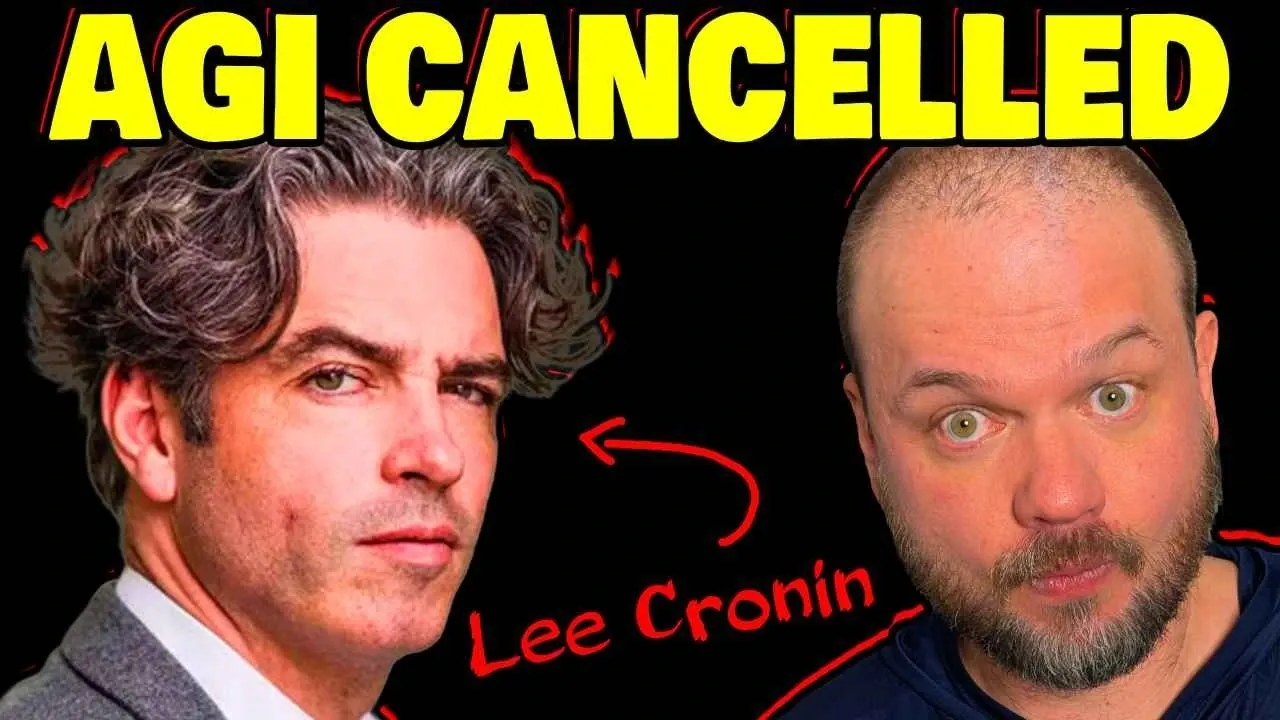
Are we overestimating what artificial intelligence can truly achieve, or worse, fearing something it can never become? In this overview, Wes Roth explores how Lee Cronin, a renowned chemist and professor at the University of Glasgow, dismantles both the utopian promises and apocalyptic fears surrounding AI. Cronin boldly critiques the idea that AI is on the brink of becoming a superintelligent force, calling such predictions speculative at best and delusional at worst. Instead, he reframes AI as a sophisticated yet fundamentally limited technology, incapable of true intelligence or autonomy. By grounding his arguments in science rather than hype, Cronin challenges the narratives that dominate public discourse, offering a refreshing take on what AI is, and what it isn’t.
This guide dives into Cronin’s critique of AI “doomers” and the exaggerated claims of AI’s fantastic potential, unpacking his scientifically grounded insights into intelligence and complexity. Readers will discover why Cronin believes the real dangers of AI lie not in its hypothetical evolution but in its misuse by humans, whether through spreading misinformation, amplifying biases, or allowing political manipulation. Along the way, you’ll encounter Cronin’s fascinating “assembly theory,” which redefines how we understand complexity and life itself. Whether you’re skeptical of AI’s promises or deeply concerned about its risks, this breakdown will leave you questioning the assumptions that shape our collective understanding of artificial intelligence.
AI Misconceptions and Realities
TL;DR Key Takeaways :
- Lee Cronin critiques both alarmist fears of AI “doomers” and exaggerated promises of AI’s fantastic potential, advocating for a balanced, evidence-based perspective on AI’s role in society.
- Cronin emphasizes that AI lacks true intelligence, including attributes like agency, imagination, and consciousness, and should be viewed as a powerful but limited tool rather than a sentient entity.
- The real risks of AI lie in its misuse by humans, such as spreading misinformation, allowing political manipulation, and perpetuating societal biases, rather than hypothetical scenarios of superintelligence.
- Cronin introduces “assembly theory,” a framework for understanding complexity and the emergence of life, bridging chemistry and biology to explore the origins of intelligence and artificial life.
- He advocates for interdisciplinary collaboration to address AI’s challenges and opportunities, integrating insights from chemistry, biology, and computer science to advance understanding of intelligence and complexity.
Cronin directly addresses the apocalyptic predictions often associated with AI “doomers,” who warn of a future where AI evolves into a superintelligent entity capable of surpassing and overpowering humanity. He dismisses these scenarios as speculative and lacking empirical evidence. According to Cronin, AI systems are not autonomous beings with free will or survival instincts but rather sophisticated tools designed to process data using probabilistic algorithms.
The real risks of AI, he asserts, lie not in its hypothetical evolution into a superintelligence but in its misuse by humans. These risks include:
- Generating and amplifying fake or misleading data
- Facilitating political manipulation and propaganda
- Reinforcing and perpetuating societal biases
Cronin emphasizes that addressing these challenges requires practical, evidence-based solutions rather than fear-driven narratives. By focusing on the tangible risks of AI misuse, he redirects attention to areas where meaningful interventions can be made.
AI: A Tool, Not True Intelligence
A central theme in Cronin’s critique is the distinction between AI as a tool and the concept of true intelligence. He argues that current AI systems, while capable of analyzing vast amounts of data and identifying patterns, lack the core attributes that define living intelligence. These systems operate within predefined parameters and cannot independently generate understanding, creativity, or decision-making capabilities.
Cronin contends that the term “artificial intelligence” is inherently misleading, as it implies a level of cognitive ability that AI does not possess. While AI can enhance productivity and solve specific problems, it does not exhibit qualities such as:
- Agency, or the ability to act independently
- Imagination, which drives creativity and innovation
- Consciousness, the self-awareness that underpins decision-making
By reframing AI as a powerful yet fundamentally limited technology, Cronin challenges the misconceptions that often surround its capabilities and potential.
Lee Cronin AI Debate, Why Agency Matters More Than Predictions

Here are more guides from our previous articles and guides related to Artificial Intelligence (AI) that you may find helpful.
- Linus Torvalds shares thoughts on artificial intelligence (AI) in
- Connectomics : Mapping the Brain using artificial intelligence (AI
- The Limitations of AI: Why Artificial Intelligence Still Needs Human
- New ZOTAC ZBOX Edge mini PCs accelerated with artificial
- Apple’s New AI Strategy for Artificial Intelligence Beyond 2025
- Machine Learning, Deep Learning and Generative AI explained
- AI vs Humans : Will Artificial Intelligence Surpass Human
- Nvidia CEO Jensen Huang Declares AI a $100 Trillion Opportunity
- Artificial Intelligence vs Quantum Computing
- Eric Schmidt’s Predictions on AI and Its Unpredictable Future
What Defines Intelligence?
To further clarify the limitations of AI, Cronin outlines a hierarchy of intelligence that highlights the attributes AI lacks. This hierarchy begins with basic evolutionary processes and progresses through increasingly complex traits, including:
- Sensing, or the ability to perceive the environment
- Memory, which allows for the retention and recall of information
- Consciousness, allowing self-awareness and reflection
- Imagination, fostering creativity and adaptability
- Free will, the capacity to make autonomous decisions
Cronin argues that true intelligence requires agency, the ability to make decisions in dynamic and unpredictable environments, often driven by survival instincts. Consciousness and imagination further enable living organisms to adapt and innovate in response to challenges. In contrast, AI systems operate within rigid, predefined frameworks and lack the ability to independently generate new ideas or goals. This distinction underscores the fundamental differences between artificial systems and living intelligence.
Assembly Theory: A Framework for Complexity
Cronin introduces “assembly theory,” a new scientific framework that seeks to quantify and understand the complexity of living systems. This theory measures molecular complexity to identify signs of life, offering a new lens through which to explore the emergence of biological and synthetic systems. According to Cronin, life is defined by its ability to create complex structures at scale through evolutionary processes.
He likens natural selection, the driving force behind evolution, to a universal principle akin to gravity. This perspective shifts the focus from traditional biological definitions of life to the underlying principles that govern complexity. Assembly theory bridges the gap between chemistry and biology, providing a unified framework for studying the origins and evolution of life. By applying this theory, researchers can better understand how complexity arises and evolves, both in natural and artificial systems.
Exploring Artificial Life Through Chemistry
Cronin’s research extends beyond theoretical frameworks to practical applications in the field of artificial life. By developing chemical systems that mimic the complexity of biological organisms, he aims to explore the origins of intelligence and life. These systems, which include “living circuits” and chemical computers, are designed to replicate the adaptability and resilience of living organisms.
This work has significant implications for understanding the principles that underpin both natural and synthetic systems. By studying artificial life, Cronin seeks to uncover the fundamental mechanisms that drive complexity and intelligence. His research highlights the potential of chemistry to advance our understanding of these phenomena, offering new insights into the interplay between biology, chemistry, and artificial systems.
Critiquing AI Hype and Misuse
In addition to addressing the exaggerated fears of AI “doomers,” Cronin critiques the overhyped promises often associated with AI. Claims that AI will lead to infinite abundance or achieve superintelligence, he argues, are not only misleading but also detract from the real challenges posed by AI. These narratives create unrealistic expectations and obscure the practical issues that require immediate attention.
Cronin advocates for a more balanced perspective that acknowledges AI’s capabilities while remaining grounded in evidence. Key areas of concern include:
- Combatting the spread of misinformation and disinformation
- Addressing ethical dilemmas related to AI deployment
- Mitigating the societal impacts of AI, particularly on employment and inequality
By focusing on these tangible challenges, Cronin calls for responsible and ethical use of AI as a tool, rather than succumbing to unfounded fears or exaggerated expectations.
Interdisciplinary Collaboration: The Path Forward
Cronin emphasizes the importance of interdisciplinary collaboration in advancing our understanding of intelligence, life, and complexity. He advocates for curiosity-driven research that integrates insights from chemistry, biology, computer science, and other fields. By grounding discussions about AI and intelligence in scientific rigor, researchers can develop a more nuanced and comprehensive understanding of these phenomena.
His work on assembly theory and artificial life exemplifies the potential of interdisciplinary approaches to address complex questions. By bridging the gaps between disciplines, Cronin’s research offers new perspectives on the nature of intelligence and the principles that govern both natural and artificial systems. This collaborative approach underscores the value of integrating diverse fields of knowledge to tackle the challenges and opportunities presented by AI and complexity.
Media Credit: Wes Roth
Filed Under: AI, Technology News, Top News
Latest Geeky Gadgets Deals
Disclosure: Some of our articles include affiliate links. If you buy something through one of these links, Geeky Gadgets may earn an affiliate commission. Learn about our Disclosure Policy.