Why Chroma’s New Context-1 20B AI Model is Beating ChatGPT 5 at Search
Chroma’s latest large language model, Context-1, introduces a new benchmark for retrieval-augmented generation (RAG) by combining precision, speed and cost-efficiency. Developed as a fine-tuned version of GBT OSS 20 billion, this specialized model is designed to handle complex search tasks with features like self-editing context windows and an agentic loop mechanism. These innovations allow Context-1 to outperform larger models, such as GPT-5, in retrieval accuracy while maintaining lower latency and operational costs. Prompt Engineering explores how this purpose-built approach addresses the inefficiencies of traditional RAG systems and highlights its potential for scalable, real-time search applications.
Gain insight into the agentic loop’s iterative retrieval strategies, which refine search results dynamically and discover how hybrid search techniques balance precision and recall for nuanced queries. You’ll also learn about the model’s expanded 32,000-token context window, which minimizes performance degradation over time and its rigorous training pipeline designed to simulate real-world challenges. This overview offers a detailed breakdown of Context-1’s capabilities, limitations and open source accessibility, providing a clear view of its role in advancing retrieval-focused AI systems.
What Sets Context-1 Apart?
TL;DR Key Takeaways :
- Chroma’s “Context-1” is a specialized large language model (LLM) optimized for retrieval-augmented generation (RAG), offering superior retrieval accuracy and reduced costs compared to larger models like GPT-5.
- Key innovations include self-editing context windows with a 32,000-token limit and an agentic loop mechanism that dynamically refines retrieval strategies for enhanced precision and relevance.
- The model employs hybrid search techniques, combining keyword-based and dense vector search methods, to achieve an optimal balance between precision and recall for complex queries.
- A rigorous training pipeline simulates real-world challenges, incorporating distractors and reasoning tasks to enhance the model’s ability to handle diverse and noisy retrieval environments.
- Context-1 is open source, with publicly available model weights and plans to release the training harness, allowing customization and fostering innovation in retrieval-augmented generation applications.
Unlike general-purpose language models, Context-1 is purpose-built for RAG, a framework that combines retrieval and generation to produce highly relevant, context-aware outputs. By focusing exclusively on search-specific applications, the model achieves superior performance through a combination of reinforcement learning and supervised training. This specialization ensures that Context-1 is not only more efficient but also more cost-effective for real-time search systems, making it a practical choice for businesses and developers alike.
Overcoming Challenges in Traditional RAG Systems
Traditional RAG systems often face significant challenges in maintaining global context during multi-step retrieval processes. Metrics such as semantic similarity frequently fail to capture the nuanced demands of complex queries, leading to suboptimal results. Additionally, using a single model to handle planning, retrieval and generation tasks can result in inefficiencies, as these tasks require distinct optimization strategies.
Context-1 addresses these limitations through a carefully engineered design that separates and optimizes each task. Its ability to maintain global context and adapt dynamically to complex queries ensures that it consistently delivers accurate and relevant results.
Take a look at other insightful guides from our broad collection that might capture your interest in ChatGPT 5.
- ChatGPT 5.4 Thinking vs Earlier Models : Token Savings and Stronger Self-Checks
- ChatGPT 5.4 1M-Token Context, Extreme Reasoning Mode: Longer Tasks, Fewer Mistakes
- ChatGPT 5.3 Upgrade Focus on Reasoning and Reliability Boost
- OpenAI GPT-5.4 Leak During Codex Demo Sparks Release Questions
- ChatGPT 5.3 Instant Cuts Unneeded Disclaimers
- Opus 4.6 vs ChatGPT 5.3 : Code Size, Speed & Build Tradeoffs
- OpenAI ChatGPT 5.4: 1M-token Context, Tool Search & New Prices
- OpenAI Codex 5.3 vs Anthropic Opus 4.6 : Coding Comparison
- Gemini 3.5 Leak Details, Early Tests Show Mixed Performance
- OpenAI GPT-5.3 Codex: 5 Things You Need to Know
The Agentic Loop: A Smarter Retrieval Strategy
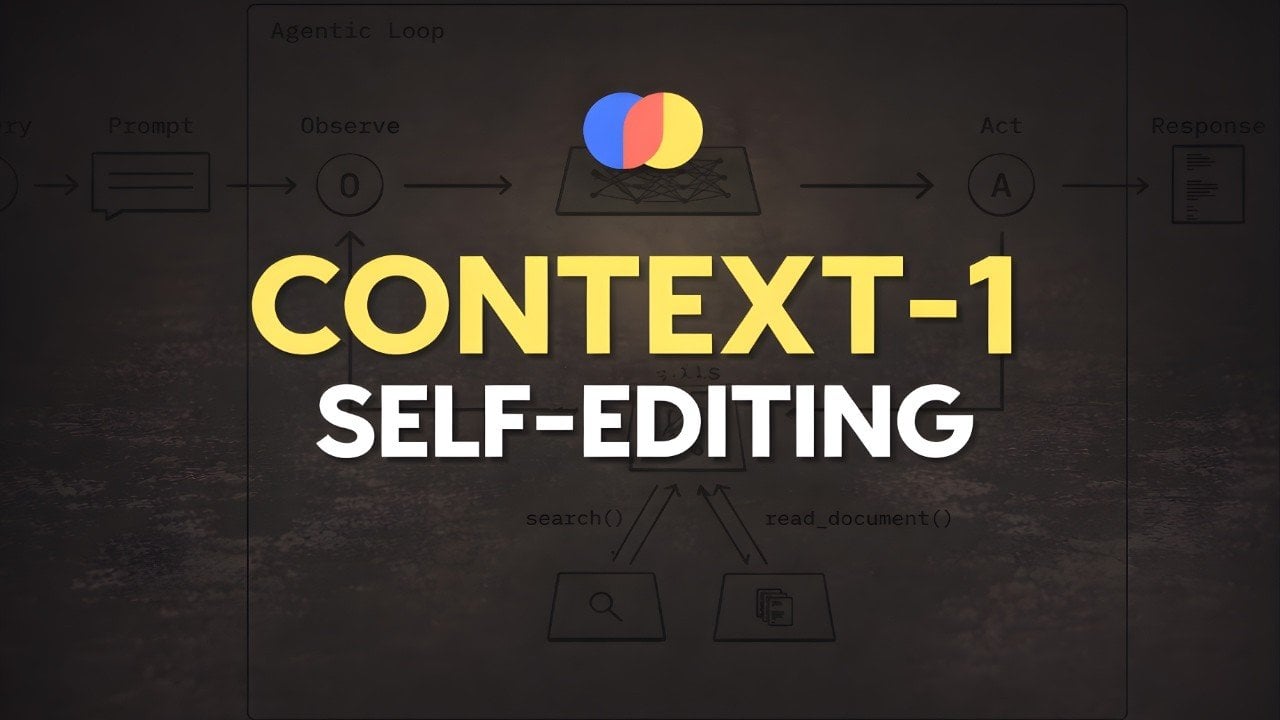
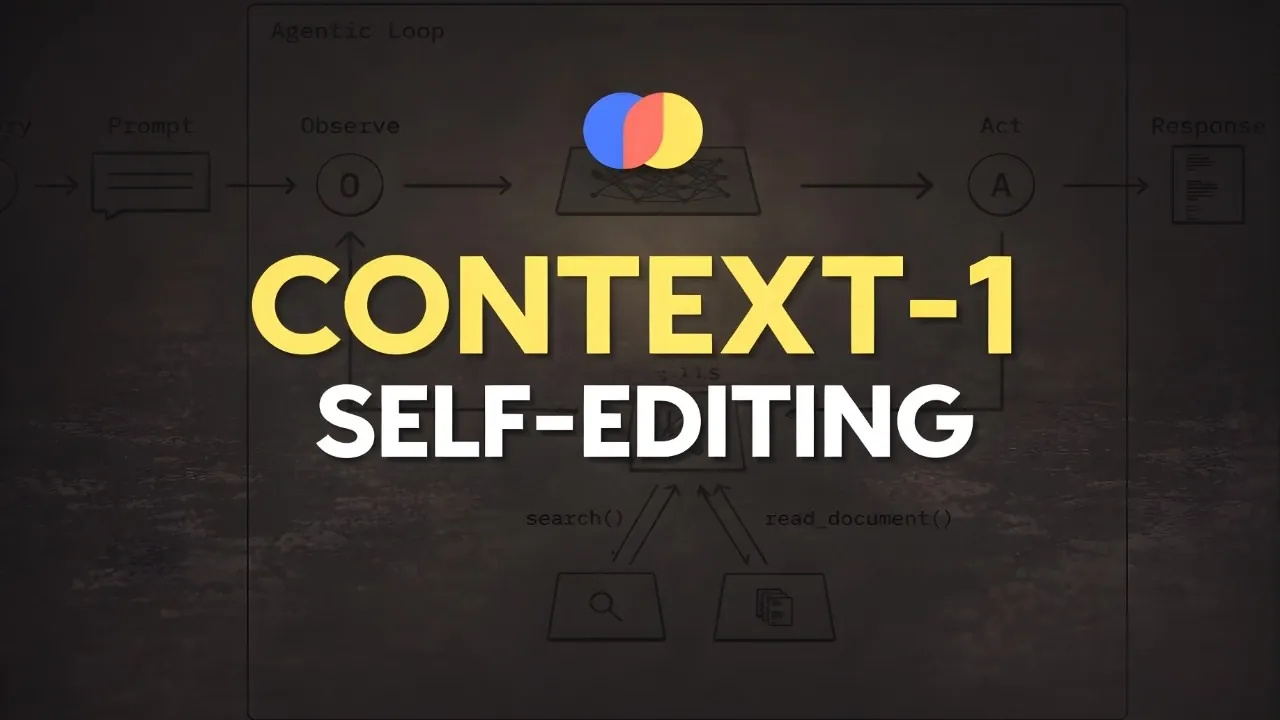
One of the most innovative features of Context-1 is its agentic loop mechanism, which redefines how retrieval strategies are executed. Unlike traditional single-step retrieval methods, the agentic loop allows the model to plan its retrieval strategy before execution. By using tools such as semantic search, vector-based retrieval, and file search, the agentic loop dynamically refines its results.
This mechanism operates iteratively, continuously updating retrieval plans, discarding irrelevant data and making sure that only the most pertinent information is retained. The result is a structured and highly efficient retrieval process that significantly enhances accuracy and relevance in complex search scenarios.
Advanced Features That Drive Performance
Context-1 incorporates several advanced features that distinguish it from traditional models:
- Self-Editing Context Window: With an expanded token limit of 32,000, the model can process large volumes of information without succumbing to “context rot,” a common issue where irrelevant data degrades performance over time.
- Hybrid Search Techniques: By combining keyword-based search methods like BM25 with dense vector search, Context-1 achieves an optimal balance between precision and recall, making sure that results are both accurate and comprehensive.
These features enable the model to handle complex, multi-layered queries with remarkable efficiency, making it an invaluable tool for applications that demand high levels of accuracy and speed.
A Rigorous Training Pipeline
The exceptional capabilities of Context-1 are supported by a robust and carefully designed training pipeline. This pipeline is specifically tailored to simulate real-world challenges, making sure that the model is well-equipped to handle diverse and complex retrieval scenarios. Key aspects of the training process include:
- Collecting documents with unique and verifiable facts to ensure the reliability of the model’s outputs.
- Introducing distractors to mimic noisy environments and test the model’s ability to filter irrelevant information.
- Generating tasks that require reasoning and verification, pushing the model to develop advanced problem-solving skills.
By training on such diverse datasets, Context-1 develops a strong ability to navigate and excel in challenging retrieval environments.
Performance and Practical Applications
Context-1 delivers exceptional retrieval accuracy, surpassing larger models like GPT-5 while operating at a fraction of the cost. Its low-latency design makes it particularly well-suited for real-time search applications, where speed and precision are critical.
However, it is important to note that Context-1 is optimized as a retrieval sub-agent and is not intended for standalone response generation. This specialization ensures that it excels in its primary role, making it an ideal choice for integration into larger systems that require highly accurate and efficient retrieval capabilities.
Open source Accessibility and Customization
Chroma has embraced an open source approach with Context-1, making the model weights publicly available. This allows developers and researchers to customize and adapt the model to meet their specific needs. Additionally, Chroma has announced plans to release the training harness and evolution code, further enhancing the model’s accessibility and utility.
This open source strategy enables users to build upon Context-1’s capabilities, fostering innovation and allowing the exploration of new applications in the field of retrieval-augmented generation.
Limitations and Future Prospects
While Context-1 offers impressive capabilities, it is not without limitations. Currently, the lack of public access to the training harness restricts reproducibility for some users. However, Chroma has committed to addressing this issue by releasing the full agent harness and evolution code in the near future.
Looking ahead, these developments are expected to broaden the model’s adoption and enable a wider range of applications. As Chroma continues to expand the Context-1 ecosystem, the model is poised to play a pivotal role in shaping the future of real-time search systems.
Media Credit: Prompt Engineering
Disclosure: Some of our articles include affiliate links. If you buy something through one of these links, Geeky Gadgets may earn an affiliate commission. Learn about our Disclosure Policy.