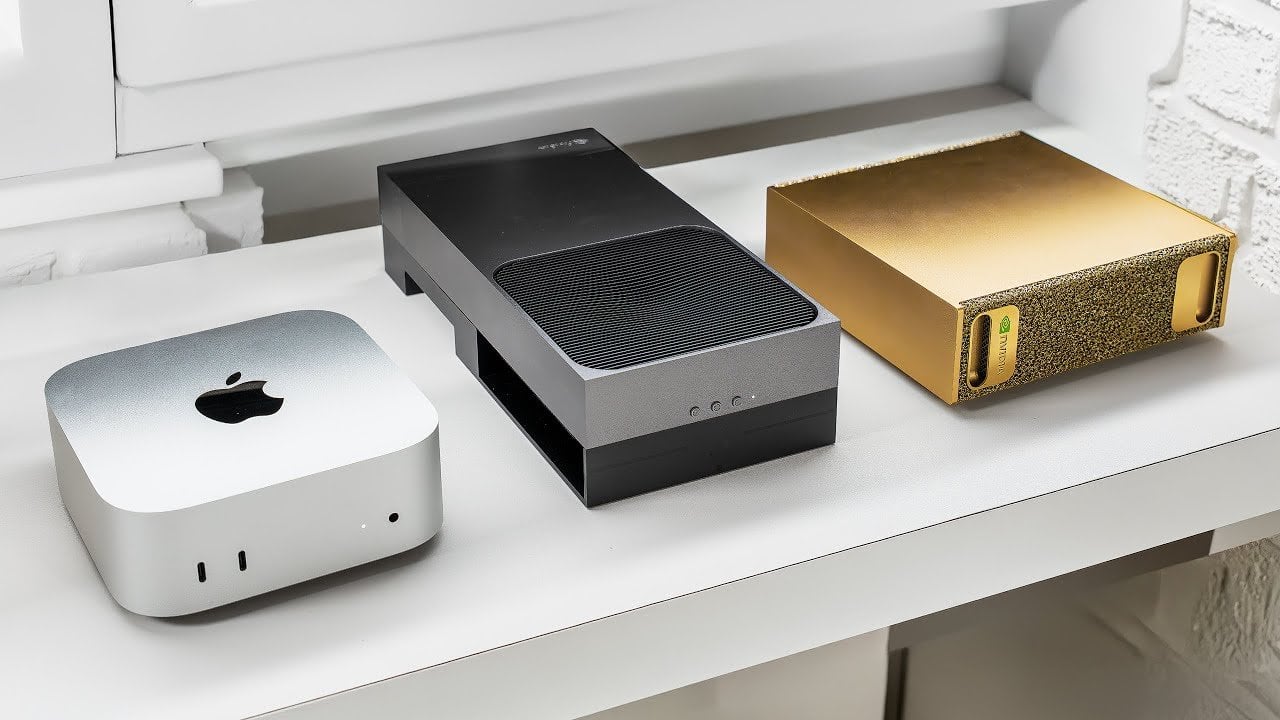
Jetson Thor vs DJX Spark vs Mac Mini M4 Pro : Local AI ML Showdown
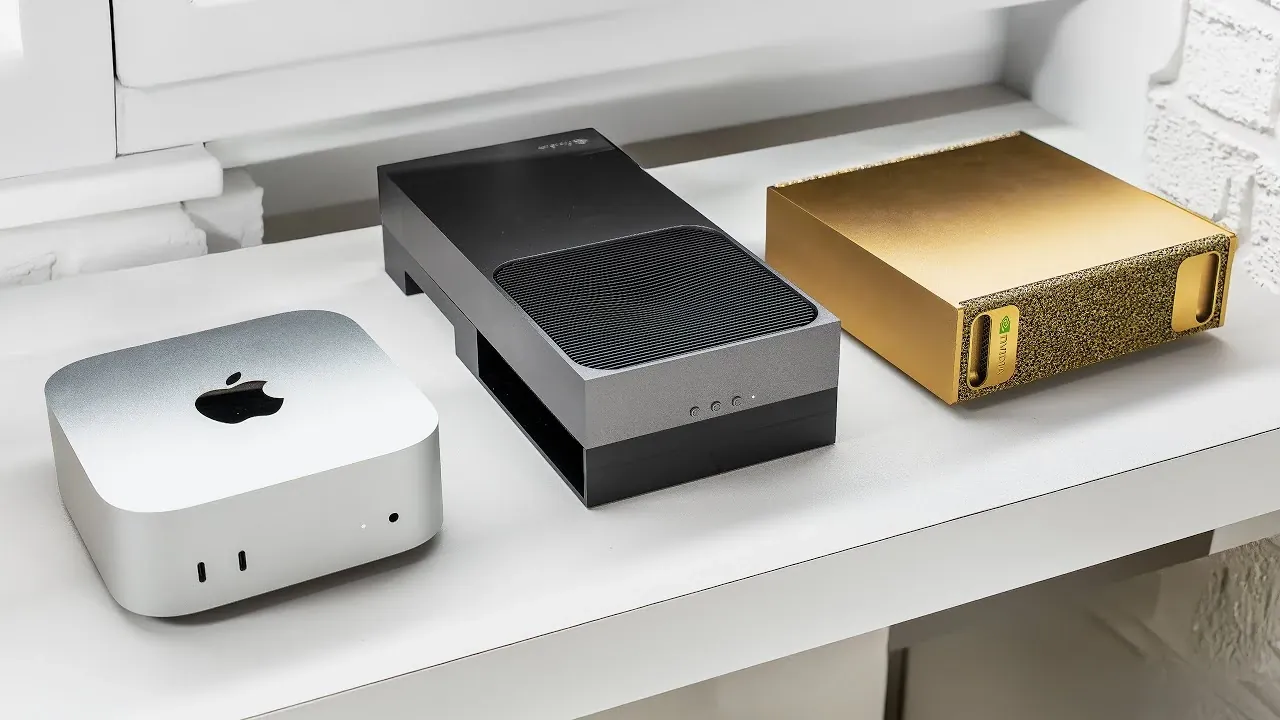
Why pay more for the same specs? In the ever-evolving world of AI hardware, where performance and efficiency reign supreme, it’s not uncommon to see devices with nearly identical specifications priced worlds apart. Take, for instance, the battle between NVIDIA’s Jetson Thor, DJX Spark, and Apple’s Mac Mini M4 Pro. Two of these systems boast a whopping 128GB of RAM, yet one comes with a price tag that’s over $1,000 lighter. It’s a stark reminder that when it comes to innovative tech, the cost isn’t always tied to capability. So, how do you decide which system delivers the best value for your needs without breaking the bank?
This overview by Alex Ziskind provides more insights into the nuances of cost-efficiency, performance benchmarks, and energy consumption across these three contenders. Whether you’re training dense machine learning models, managing sparse workloads, or simply seeking a reliable, energy-efficient system for smaller tasks, each device offers a distinct set of strengths. But which one strikes the perfect balance for your priorities? As you navigate the trade-offs between memory capacity, power consumption, and hardware architecture, you might discover that the most affordable option doesn’t just save you money, it might also be the smartest choice.
AI Hardware Comparison
TL;DR Key Takeaways :
- The NVIDIA Jetson Thor and DJX Spark both feature 128GB of RAM, making them ideal for memory-intensive AI tasks, while the Mac Mini M4 Pro offers 64GB, suitable for smaller-scale machine learning applications.
- The Jetson Thor is the most cost-efficient option, priced over $1,000 less than the DJX Spark, while the Mac Mini M4 Pro provides a budget-friendly solution for lightweight tasks.
- Power efficiency varies, with the Mac Mini M4 Pro consuming just 8 watts, the Jetson Thor using 31 watts, and the DJX Spark consuming 44 watts during basic operations, reflecting their performance capabilities.
- Hardware architecture differs, with the DJX Spark using a 3nm CPU process for high-demand workloads, the Jetson Thor focusing on deterministic latency with a 4nm CPU process, and the Mac Mini M4 Pro offering a simpler, versatile design.
- Cooling systems are optimized for each device, with the DJX Spark featuring advanced cooling for intensive tasks, the Jetson Thor balancing performance and heat management, and the Mac Mini M4 Pro requiring minimal cooling due to its low power usage.
Memory and Cost Efficiency
Memory capacity is a cornerstone of AI hardware performance, directly influencing the ability to handle complex machine learning tasks. Both the Jetson Thor and DJX Spark are equipped with 128GB of RAM, making them ideal for memory-intensive workloads such as training large-scale models like Llama 3.3 70B. However, the Jetson Thor distinguishes itself as the more budget-friendly option, priced over $1,000 less than the DJX Spark. This affordability makes it an attractive choice for users who need high memory capacity without exceeding their budget.
In contrast, the Apple Mac Mini M4 Pro, with its 64GB of RAM, is better suited for smaller-scale machine learning tasks. While it lacks the capacity for training dense models, it remains a cost-effective solution for lightweight applications. Its ability to efficiently handle smaller workloads ensures that users with less demanding requirements can still achieve reliable performance without investing in excessive hardware.
Performance Benchmarks: Dense vs. Sparse Models
Performance varies significantly across these systems, particularly in their ability to handle dense and sparse model workloads. The DJX Spark excels in processing sparse models such as GPT OSS 12B, thanks to its 3nm CPU process and optimized GPU cores. These features enable faster computation, higher throughput, and superior performance in tasks like prompt processing and token generation.
The Jetson Thor, while less powerful overall, performs competitively with dense models like Llama 3.3 70B. Although it operates at a slower pace compared to the DJX Spark, it remains a viable option for users focused on dense model training. Meanwhile, the Mac Mini M4 Pro struggles with memory-intensive tasks due to its lower RAM capacity, but it delivers consistent and reliable performance for smaller-scale machine learning applications.
Jetson Thor vs DJX Spark & When to Pick Apple M4 Pro Mac Mini Instead
Below are more guides on local AI hardware from our extensive range of articles.
- Running AI Locally: Best Hardware Configurations for Every Budget
- Best GPUs for Local AI, VRAM Needs and Price Tiers Explained
- Local AI Setup Guide for Apple Silicon : Get a Big Boosts for Speed
- Best Local AI Models for the Base Mac Mini M4, Speed & Limits
- Run a 600 Billion Parameter AI Model Locally on Your PC
- How the NVIDIA DGX Spark Redefines Local AI Computing Power
- Build a Local Qwen3-VL AI Security System with Drones & Phones
- Deepseek R1 671b: How to Run This AI Model Locally Optimize
- How to build a high-performance AI server locally
- Why Local AI Processing is the Future of Robotics
Power Consumption and Efficiency
Power efficiency is a critical factor, particularly for users aiming to minimize energy consumption. The Mac Mini M4 Pro leads in this category, consuming just 8 watts during basic operations. This low power usage makes it an excellent choice for general-purpose use and lightweight machine learning tasks, especially in environments where energy savings are a priority.
The Jetson Thor strikes a balance between power efficiency and performance, consuming approximately 31 watts during standard operations. This moderate power usage makes it suitable for users who require a balance of computational power and energy efficiency. On the other hand, the DJX Spark, while offering superior computational capabilities, consumes 44 watts during basic operations, with energy usage nearly doubling under heavy workloads. This higher power consumption reflects its advanced performance but may be a drawback for users with strict energy constraints.
Hardware and Architecture
The hardware architecture of these systems plays a significant role in their performance and suitability for various tasks. Both the Jetson Thor and DJX Spark use NVIDIA’s Blackwell chips, which feature advanced Tensor and CUDA cores designed to accelerate AI workloads. However, the DJX Spark’s 3nm CPU process enhances CPU-to-GPU communication, making it particularly effective in multi-user environments and high-demand scenarios.
The Jetson Thor, built on a 4nm CPU process, prioritizes deterministic latency, making it well-suited for applications requiring consistent response times, such as robotics and automotive systems. In contrast, the DJX Spark is optimized for bursty, high-demand workloads, making it ideal for multi-user AI applications. The Mac Mini M4 Pro, while less specialized, offers a simpler architecture that supports general-purpose tasks effectively. Its straightforward design ensures compatibility with a wide range of applications, making it a versatile option for users with diverse needs.
Cooling Systems and GPU Load Variability
Efficient cooling systems and GPU load management are essential for maintaining performance under heavy workloads. The DJX Spark features an advanced cooling system that operates quietly, even during intensive tasks. This ensures consistent performance and reliability, despite its higher power consumption.
The Jetson Thor, while less power-hungry, exhibits some variability in GPU load handling. This can lead to minor fluctuations in performance during demanding tasks, though it remains a dependable option for most applications. The Mac Mini M4 Pro, with its lower power requirements, generates minimal heat and operates efficiently without the need for complex cooling systems. This simplicity enhances its appeal for general-purpose and lightweight machine learning tasks, where heat management is less of a concern.
Use Cases and Recommendations
Choosing the right system depends on your specific requirements, priorities, and budget. Each of these devices offers unique advantages tailored to different use cases:
- Jetson Thor: Ideal for cost-conscious users who prioritize power efficiency and deterministic performance. Best suited for robotics, automotive systems, and dense model workloads.
- DJX Spark: Designed for high-performance, multi-user environments requiring faster processing and superior handling of sparse models. A strong choice for users with demanding computational needs.
- Mac Mini M4 Pro: A reliable option for lightweight machine learning tasks and general-purpose use. Its energy efficiency and simplicity make it an excellent choice for users focused on minimizing power consumption.
Each system offers distinct strengths, making sure that users can find a solution that aligns with their specific needs and expectations. Whether you prioritize cost, performance, or energy efficiency, these devices provide a range of options to support your machine learning endeavors.
Media Credit: Alex Ziskind
Filed Under: AI
Latest Geeky Gadgets Deals
Disclosure: Some of our articles include affiliate links. If you buy something through one of these links, Geeky Gadgets may earn an affiliate commission. Learn about our Disclosure Policy.