Agent-Style AI Coding Model Cracks Full-Stack Tasks and Complex Debugging
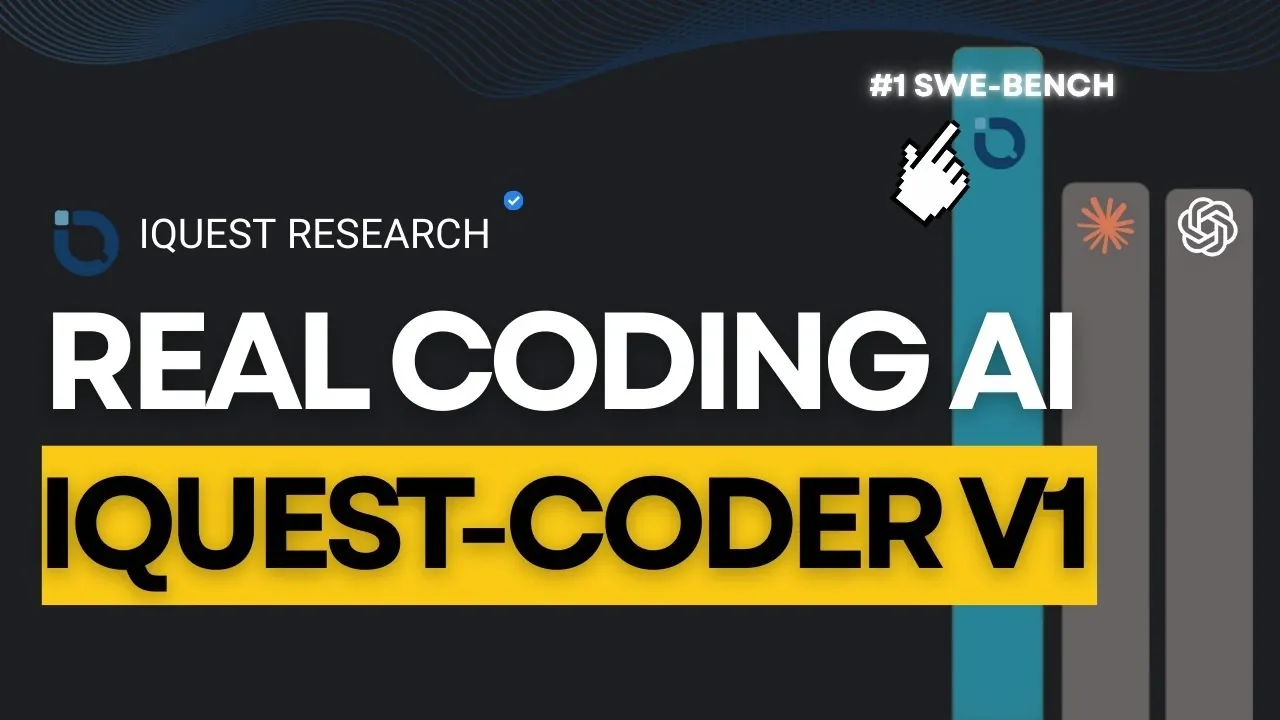
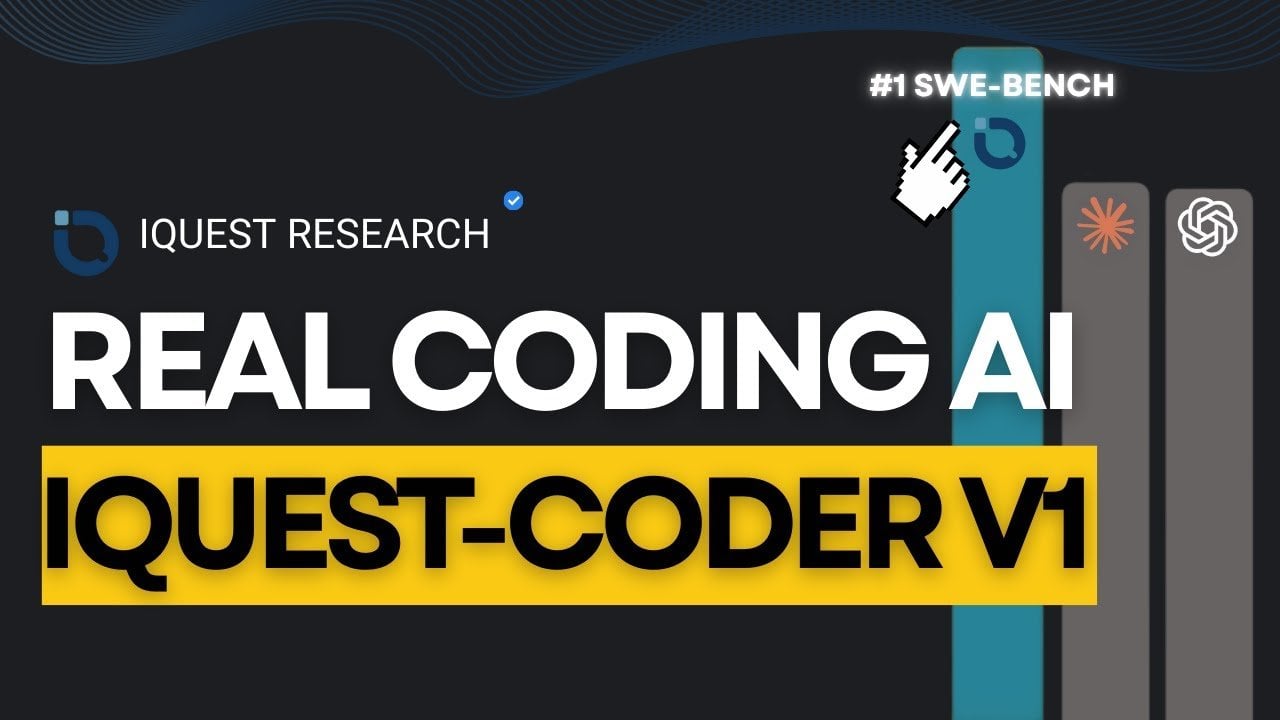
What if the future of coding wasn’t just faster but fundamentally smarter? Below, Universe of AI takes you through how China’s IQ Quest Coder (IQC) has redefined the boundaries of AI-driven software development, leaving even giants like GPT-5.1 and Claude Sonnet 4.5 in its wake. With its ability to debug complex systems, reason across entire repositories, and adapt to intricate workflows, IQC doesn’t just assist developers, it transforms how they approach their craft. Imagine an AI that not only writes code but thinks critically about it, solving problems you didn’t even know existed. That’s the promise IQC delivers, and it’s already making waves in the tech world.
In this guide, we’ll explore what makes IQC such a standout in the crowded AI landscape. From its new “loop coder” architecture to its dual-path fine-tuning approach, IQC is packed with innovations designed to tackle the toughest challenges in modern software engineering. Whether you’re curious about its ability to handle extended context lengths or its performance on real-world benchmarks, this breakdown will give you a glimpse into why IQC is being hailed as a fantastic option for developers worldwide. As you uncover the details, you might find yourself wondering: Is this the beginning of a new era in intelligent coding?
Why IQ Quest Coder Stands Out
TL;DR Key Takeaways :
- IQ Quest Coder (IQC) Version 1 is a new AI model designed to surpass competitors like GPT-5.1 and Claude Sonnet 4.5, excelling in debugging, repository-level reasoning, and tool-augmented workflows.
- IQC features three configurations (7B, 14B, and 40B parameters) and introduces a novel “loop coder” architecture, optimizing resource usage while maintaining high performance and scalability.
- The model’s three-stage training pipeline (pre-training, mid-training, and post-training) equips it with advanced reasoning, extended context processing, and adaptability for diverse coding tasks.
- IQC outperforms competitors in benchmarks like debugging, multi-step problem-solving, API integrations, and full-stack development, showcasing its precision and efficiency in complex workflows.
- Real-world demonstrations, including simulations and 3D applications, highlight IQC’s versatility and potential to transform software engineering by addressing dynamic, multi-faceted challenges.
IQC is available in three configurations, 7B, 14B, and 40B parameters, with the 40B model serving as the flagship version. What makes IQC unique is its ability to handle tasks requiring deep reasoning and repository-level understanding. Its architecture and training pipeline are carefully designed to address the intricate demands of modern software development. This makes IQC a versatile and powerful solution for developers seeking to enhance productivity and tackle complex coding challenges with confidence.
The model’s ability to process extended context lengths and its dual-path fine-tuning approach ensure it is not only a tool for routine coding but also a resource for solving intricate problems. By focusing on reasoning and adaptability, IQC sets itself apart as a next-generation AI model tailored for the evolving needs of software engineering.
How IQC Was Built: A Three-Stage Training Pipeline
IQC’s advanced capabilities are the result of a carefully designed three-stage training pipeline, which equips the model with the skills needed to excel in diverse coding environments:
- Stage 1: Pre-training
IQC is pre-trained on an extensive dataset comprising general text and large-scale code repositories. This foundational phase provides the model with a broad understanding of programming languages, patterns, and structures, allowing it to recognize and generate high-quality code across various domains. - Stage 2: Mid-training
In this stage, IQC is trained with extended context lengths of up to 128,000 tokens. This allows the model to analyze and process complex, interconnected codebases, focusing on repository-level reasoning and long-term dependencies. This capability is critical for tasks that require a comprehensive understanding of large-scale projects. - Stage 3: Post-training
The final stage involves fine-tuning IQC along two specialized paths. The “instruct” variant is optimized for general coding tasks, while the “thinking” variant is tailored for advanced reasoning and self-correction. This dual-path approach ensures that IQC can adapt to a wide range of use cases, from routine coding to solving intricate problems.
China’s New Coding AI Beats GPT-5.1 & Claude Sonnet 4.5
Browse through more resources below from our in-depth content covering more areas on AI Coding.
- Ralph AI Coding Plugin : Helps Claude Finish Any Task Effeciently
- ChatGPT 5 vs Claude Sonnet: Real-World AI Coding Comparison
- SpecKit Review: GitHub’s New Tool for Reliable AI Coding
- Codex vs Claude Code: A Detailed Comparison of AI Coding CLIs
- ChatGPT 5 vs Claude Opus 4.1: AI Coding Assistant Comparison
- Save Money on AI Coding: Use Free Extensions In VS Code
- Gemini Coder 2 Build Mode : Free AI Coding Tool You Need to Try
- New Claude Code 2.0 Agentic AI Coding Agent : The Secret
- How the Claude SANDBOX Method Makes AI Coding 90% Faster
- Auto Claude: Free Open Source AI Coding Assistant with GitHub
Innovative Architecture: The Loop Coder Design
IQC introduces a novel “loop coder” architecture, which represents a significant advancement in AI design. This architecture reuses transformer blocks iteratively instead of adding more layers, reducing memory usage and hardware demands while maintaining high performance. The result is a scalable and efficient model capable of handling complex tasks without compromising speed or accuracy.
By optimizing resource utilization, the loop coder design ensures that IQC can operate effectively even in resource-constrained environments. This innovation not only enhances the model’s performance but also makes it more accessible to a broader range of developers and organizations.
Benchmark Results: How IQC Outperforms Competitors
IQC’s performance has been rigorously evaluated across multiple benchmarks, consistently demonstrating its superiority over competitors. These benchmarks highlight the model’s ability to handle a wide range of tasks with precision and efficiency:
- Software Engineering Bench: IQC showcases exceptional debugging skills, accurately generating patches for real GitHub issues and resolving complex bugs.
- Live Codebench: The “thinking” variant excels in reasoning-intensive tasks, outperforming the “instruct” version in multi-step problem-solving and logical reasoning.
- Big Code Bench: IQC handles large-scale compositional tasks, such as API integrations and multi-step instructions, demonstrating its ability to manage complex workflows seamlessly.
- Terminal Bench: The model operates efficiently in terminal environments, managing dependencies, executing workflows, and automating repetitive tasks with ease.
- Full Stack Bench: IQC delivers outstanding performance in end-to-end application development, covering backend, frontend, and integration tasks comprehensively.
These results underscore IQC’s ability to address the diverse challenges of modern software engineering, making it a valuable asset for developers and organizations alike.
Real-World Applications and Demonstrations
Beyond benchmarks, IQC has proven its capabilities in real-world simulations and demonstrations, showcasing its practical applications in various scenarios:
- Real-time Simulations: IQC demonstrates iterative reasoning in interactive demos, such as pixel sandboxes and flocking algorithms, highlighting its ability to adapt and respond to dynamic environments.
- 3D Simulation: A full solar system simulation illustrates IQC’s ability to integrate physics, rendering, and user input handling into a cohesive application, showcasing its versatility in handling complex, multi-faceted projects.
These demonstrations highlight IQC’s potential to transform software development by providing developers with an intelligent, adaptable tool capable of addressing real-world challenges effectively.
Redefining Software Engineering
IQ Quest Coder Version 1 represents a significant advancement in AI-driven software development. By focusing on reasoning, debugging, and repository-level understanding, IQC transcends traditional autocomplete models to function as an intelligent, autonomous coding assistant. Its innovative architecture, advanced training pipeline, and superior benchmark performance establish it as a leader in the field.
IQC’s ability to process extended context lengths, adapt to diverse use cases, and deliver high-quality results positions it as a fantastic tool for developers. As the demands of software engineering continue to evolve, IQC offers a powerful ally in tackling the complexities of modern development, paving the way for a new era of intelligent, reasoning-driven AI models.
Media Credit: Universe of AI
Filed Under: AI
Latest Geeky Gadgets Deals
Disclosure: Some of our articles include affiliate links. If you buy something through one of these links, Geeky Gadgets may earn an affiliate commission. Learn about our Disclosure Policy.