• ChatGPT 5.2 Outpaces Rivals on Swebench Pro & GPQA : Big Gains in Speed & Cost

    ChatGPT 5.2 Outpaces Rivals on Swebench Pro & GPQA : Big Gains in Speed & Cost

    ChatGPT 5.2 Outpaces Rivals on Swebench Pro & GPQA : Big Gains in Speed & Cost

    A comparison chart showing GPT-5.2 beating rivals on Swebench Pro and GPQA with fewer mistakes and faster responses.

    What if the AI you’ve been using just got 390 times more efficient at solving complex problems? Imagine a tool so advanced it could process vast datasets, generate precise insights, and even outperform its rivals in coding and real-world applications, all while cutting costs for intensive tasks. OpenAI’s latest release, ChatGPT 5.2, is exactly that: a new leap in artificial intelligence that’s shaking up the industry. With its enhanced reasoning skills, long-context processing capabilities, and refined visual understanding, this model doesn’t just raise the bar, it redefines it. But with a higher price tag and fierce competition from rivals like Claude Opus 4.5, is GPT-5.2 truly the AI revolution we’ve been waiting for?

    In this deep dive, Matthew Berman explores the fantastic upgrades that make GPT-5.2 a standout in the AI landscape. From its ability to tackle intricate programming challenges to its versatility across industries like finance, travel, and healthcare, this model promises to reshape how businesses and developers approach innovation. But it’s not all smooth sailing, there are trade-offs to consider, including its pricing structure and the ever-present challenge of staying ahead in a competitive market. Whether you’re a tech enthusiast, developer, or business leader, this exploration will unpack the potential, the pitfalls, and the profound implications of OpenAI’s latest creation. After all, when the future of AI evolves this quickly, the only question left is: are you ready to keep up?

    ChatGPT 5.2 : Key Highlights

    TL;DR Key Takeaways :

    • ChatGPT 5.2 introduces significant advancements in reasoning, operational efficiency, and adaptability, setting a new benchmark in AI performance.
    • The model excels in long-context processing with up to 256,000 tokens and achieves a 390x cost efficiency improvement for ARC AGI 2 tasks compared to GPT-5.1.
    • Enhanced visual reasoning capabilities reduce error rates in tasks like chart analysis and image-based data extraction, benefiting industries reliant on accurate data interpretation.
    • ChatGPT 5.2 reduces hallucination rates and improves document extraction, making it a reliable tool for automating workflows and extracting actionable insights.
    • Despite higher pricing, its improved cost efficiency and superior performance in enterprise-specific tasks make it a valuable investment for businesses and developers.

    Performance Breakthroughs: A New Era in AI Efficiency

    ChatGPT 5.2 achieves exceptional results across multiple industry-standard benchmarks, including Swebench Pro, GPQA Diamond, Amy 2025, and ARC AGI 2. These benchmarks highlight its superior reasoning capabilities, particularly in long-context processing, where it maintains high accuracy with up to 256,000 tokens. This advancement enables the model to handle extensive and complex datasets with remarkable precision. Compared to its predecessor, GPT-5.1, the new model offers an impressive 390x cost efficiency improvement for ARC AGI 2 tasks, making it a more economical and effective solution for computationally intensive challenges.

    In the realm of coding, GPT-5.2 achieves an ELO score of 1486, positioning it as a leader in solving intricate programming problems, second only to Claude Opus 4.5. This performance underscores its value as a critical resource for software development, automation, and debugging, allowing developers to streamline workflows and tackle complex projects with confidence.

    Real-World Applications: Versatility Across Industries

    The advancements in GPT-5.2 extend far beyond theoretical benchmarks, offering tangible benefits across a wide array of industries. Its enhanced visual reasoning capabilities significantly reduce error rates in tasks such as chart analysis, software interface interpretation, and image-based data extraction. These improvements are particularly advantageous for businesses that depend on accurate data analysis and visualization.

    The model demonstrates exceptional proficiency in workforce planning, cap table management, and project reporting, delivering improved accuracy and operational efficiency. Additionally, GPT-5.2 excels in automating customer support and flight rebooking processes, seamlessly handling multi-step tasks with precision. These capabilities highlight its versatility and potential to transform operations in industries ranging from finance to travel.

    ChatGPT 5.2 Performance Update, Benchmarks & Real-World Gains

    Here are more detailed guides and articles that you may find helpful on ChatGPT 5.

    Technical Enhancements: Tackling Core Challenges

    One of the most notable improvements in GPT-5.2 is its significantly reduced hallucination rate compared to GPT-5.1. This enhancement ensures greater reliability and accuracy in its outputs, making it a dependable tool for critical applications where precision is paramount. The model’s refined visual reasoning abilities further enhance its capacity to identify and interpret elements within images, expanding its utility in fields such as design, diagnostics, and quality control.

    For enterprise users, GPT-5.2 offers enhanced performance in document extraction and analytical queries. These improvements make it an invaluable resource for automating complex workflows, extracting actionable insights from large datasets, and improving decision-making processes. By addressing key technical challenges, GPT-5.2 reinforces its position as a leader in AI-driven innovation.

    Economic Considerations: Balancing Cost and Value

    The pricing structure for GPT-5.2 reflects its enhanced capabilities, with input tokens priced at $1.75 per million and output tokens at $14 per million, compared to $1.25 and $10, respectively, for GPT-5.1. While the increase may raise concerns for some users, the model’s improved cost efficiency for handling complex tasks offsets this adjustment, making it a worthwhile investment for businesses seeking advanced AI solutions.

    The model is available to paid users across all versions, including Instant, Thinking, and Pro, making sure accessibility for a wide range of use cases. This availability allows businesses and developers to quickly integrate GPT-5.2 into their workflows, accelerating innovation and operational efficiency.

    Competitive Edge: Outperforming Rivals

    GPT-5.2 solidifies its position as a leader in the AI landscape by outperforming competitors such as Gemini 3 Pro and Claude Opus 4.5 in key benchmarks. Its faster response times and higher accuracy in enterprise-specific tasks make it an attractive choice for organizations seeking reliable and efficient AI solutions.

    The model’s superior performance extends to specialized applications, including telecom operations, mental health evaluations, and advanced customer service automation. These achievements demonstrate its ability to address complex challenges across diverse sectors while maintaining high levels of efficiency and precision. By consistently outperforming its rivals, GPT-5.2 reinforces OpenAI’s commitment to delivering innovative AI technology.

    A Fantastic Step in AI Development

    GPT-5.2 represents a significant leap forward in artificial intelligence, combining enhanced performance with practical applications across industries. Its improvements in reasoning, visual understanding, and long-context processing redefine the standards for large language models, offering unparalleled capabilities for businesses and developers alike.

    By addressing critical challenges such as hallucination reduction and refining its technical capabilities, GPT-5.2 underscores OpenAI’s dedication to innovation and reliability. Whether managing intricate workflows, automating customer interactions, or analyzing complex datasets, GPT-5.2 provides the tools necessary to thrive in an increasingly AI-driven world. Its versatility, efficiency, and enterprise utility make it a compelling choice for those seeking to harness the full potential of artificial intelligence.

    Media Credit: Matthew Berman

    Filed Under: AI, Technology News, Top News

    Latest Geeky Gadgets Deals

    Disclosure: Some of our articles include affiliate links. If you buy something through one of these links, Geeky Gadgets may earn an affiliate commission. Learn about our Disclosure Policy.
  • SunFounder Fusion Raspberry Pi HAT+ : Build AI Voice Assistants & Robots Faster

    SunFounder Fusion Raspberry Pi HAT+ : Build AI Voice Assistants & Robots Faster

    SunFounder Fusion Raspberry Pi HAT+ : Build AI Voice Assistants & Robots Faster

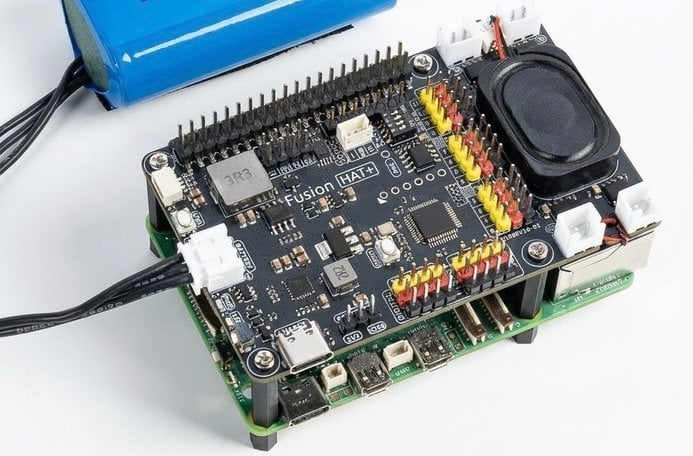
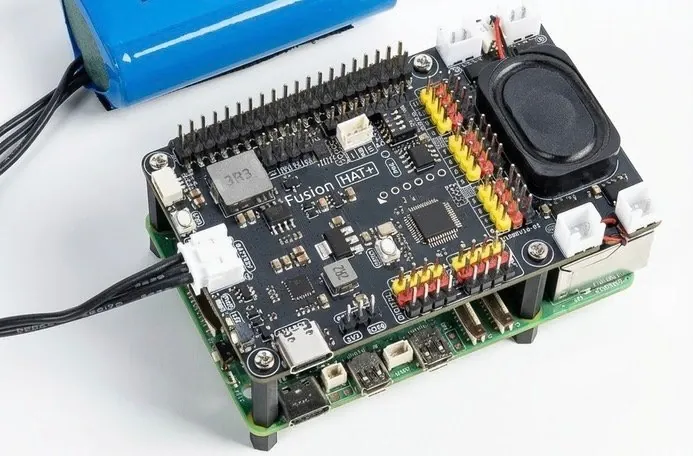
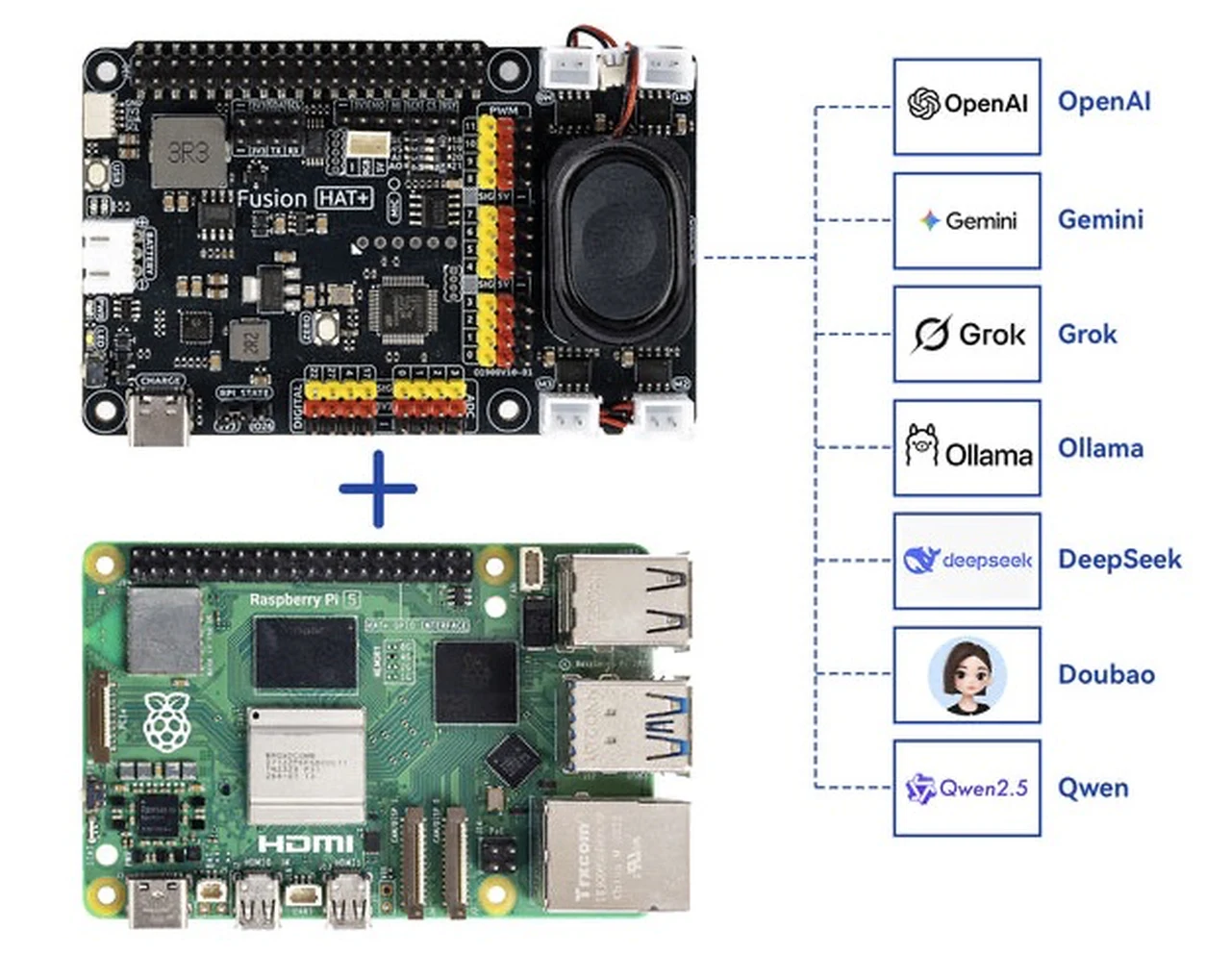
    SunFounder Fusion HAT+ mounted on a Raspberry Pi 5, showing motor headers, servo ports, and battery connector.

    What if your Raspberry Pi could do more than you ever imagined, like powering a humanoid robot, automating your home, or running advanced AI models? With the launch of the SunFounder Fusion HAT+, that vision is now within reach. This innovative expansion board is engineered to transform your Raspberry Pi into a powerhouse of innovation, offering seamless compatibility with models ranging from the latest Raspberry Pi 5 to the compact Zero 2W. Whether you’re a curious beginner or a seasoned developer, the Fusion HAT+ promises to unlock new possibilities in robotics, AI, and smart systems, all at an accessible price point.

    In this overview, we’ll explore how the Fusion HAT+ stands out with its advanced hardware features and support for leading AI platforms like OpenAI and Gemini AI. From precise motor control to built-in audio capabilities, this board is designed to handle complex, real-world challenges. You’ll discover how it enables creators to build everything from autonomous vehicles to voice-controlled assistants, all while making sure reliable power management and ease of use. If you’ve ever dreamed of pushing the boundaries of what your Raspberry Pi can achieve, this might just be the upgrade you’ve been waiting for.

    Fusion HAT+ Overview

    TL;DR Key Takeaways :

    • The SunFounder Fusion HAT+ is a versatile expansion board compatible with multiple Raspberry Pi models, including Raspberry Pi 5, 4, 3B+, and Zero 2W, designed for robotics, home automation, and AI applications.
    • It features advanced hardware capabilities such as motor control, sensor integration, connectivity interfaces (I2C, SPI, UART), and built-in audio components, allowing complex and innovative projects.
    • The board supports leading AI platforms like OpenAI, Gemini AI, and DeepSeek AI, allowing developers to integrate advanced AI functionalities such as voice recognition and machine learning.
    • Reliable power management includes a rechargeable battery, USB Type-C charging, power protection, and safe shutdown features, making sure uninterrupted operation for demanding projects.
    • Priced at £26.17 GBP, the Fusion HAT+ offers affordability, extensive documentation, Python libraries, and community support, making it accessible to users of all skill levels, from beginners to professionals.

    SunFounder has introduced the Fusion HAT+, a highly versatile expansion board designed to elevate Raspberry Pi projects to new heights. This innovative board is compatible with a wide range of Raspberry Pi models, including the latest Raspberry Pi 5, as well as earlier versions like the Raspberry Pi 4, 3B+, and Zero 2W. With its robust features and broad compatibility, the Fusion HAT+ is ideal for applications in robotics, home automation, and artificial intelligence (AI). Whether you are a beginner or an experienced developer, this expansion board provides a powerful platform to bring your creative ideas to life.

    SunFounder Fusion Raspberry Pi HAT+

    Seamless Compatibility Across Models and AI Platforms

    The Fusion HAT+ is designed to integrate effortlessly with multiple Raspberry Pi models, making sure flexibility for users with different setups. Its compatibility extends to the Raspberry Pi 5, 4, 3B+, and Zero 2W, making it a practical choice for both new and existing Raspberry Pi users. Beyond hardware, the Fusion HAT+ supports leading Large Language Models (LLMs) such as OpenAI, Gemini AI, and DeepSeek AI. This capability allows developers to incorporate advanced AI functionalities into their projects, allowing innovations in voice recognition, machine learning, and intelligent automation.

    Advanced Hardware Features for Complex Projects

    The Fusion HAT+ is equipped with a range of advanced hardware features that make it suitable for diverse applications. These include:

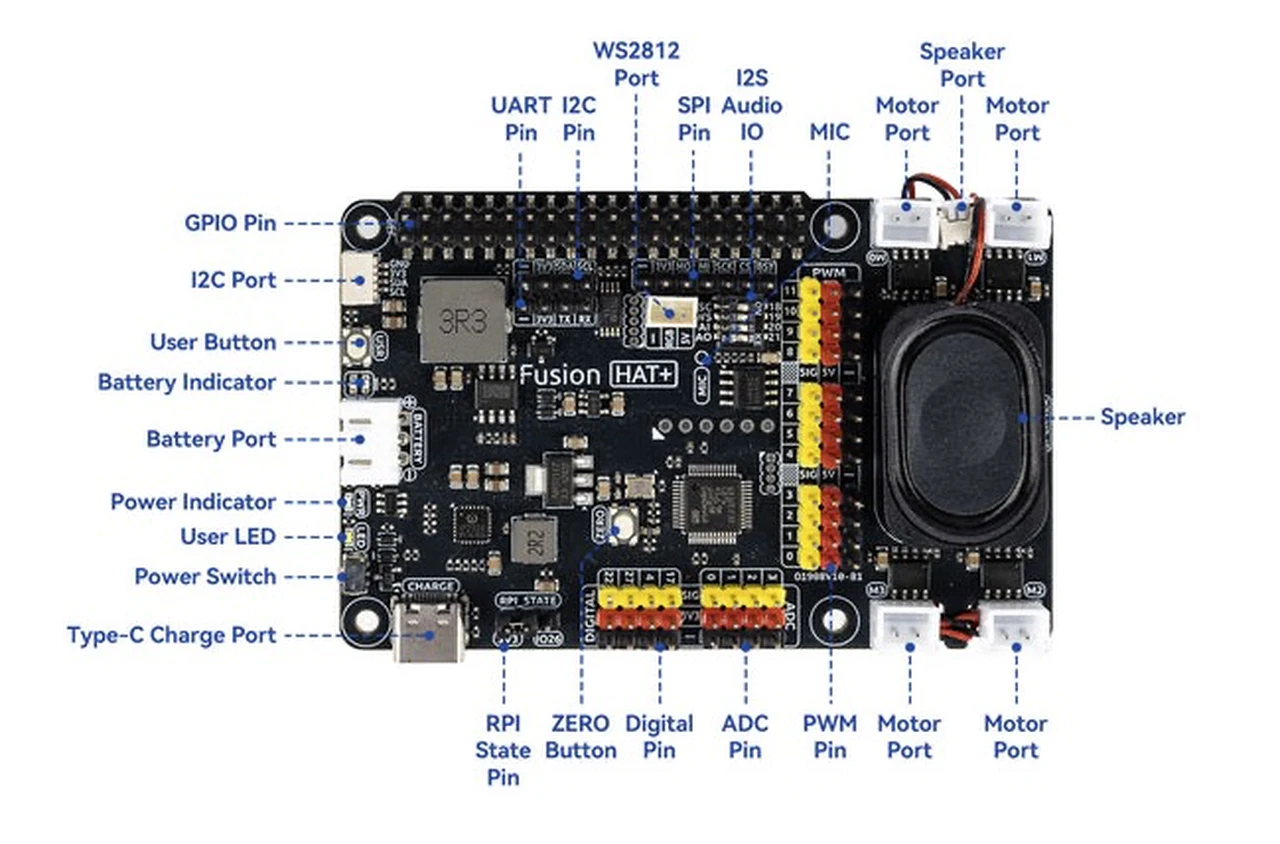
    • Motor Control: Four DC motor drivers and 12 PWM servo channels, allowing precise control of robotic movements.
    • Sensor Integration: Four 12-bit ADC inputs for seamless analog-to-digital conversion, essential for connecting various sensors.
    • Connectivity: Interfaces such as I2C, SPI, and UART for efficient communication with external devices and modules.
    • Audio Capabilities: A built-in speaker and microphone, perfect for voice-controlled systems and audio feedback applications.

    These features provide the foundation for building intricate systems, from robotic arms to AI-powered devices, offering users the tools they need to tackle complex challenges.

    Innovative Applications in Robotics and Smart Systems

    The Fusion HAT+ is tailored to meet the demands of modern robotics and smart systems, making it an excellent choice for developers aiming to create innovative projects. Its capabilities enable the development of:

    • Autonomous smart cars equipped with navigation and obstacle detection systems.
    • Humanoid robots capable of interacting with their environment and performing tasks.
    • Robotic arms designed for precision tasks in industrial, educational, or research settings.
    • Multi-legged robots for advanced mobility and stability experiments.
    • AI-driven voice assistants and home automation systems for smarter living environments.

    With its compatibility with AI platforms and robust hardware, the Fusion HAT+ enables users to explore innovative solutions in robotics and automation.

    Reliable Power Management for Uninterrupted Operation

    Power stability is a critical factor in any project, and the Fusion HAT+ addresses this with a well-designed power management system. It includes a rechargeable 7.4V, 14.8Wh battery and USB Type-C charging for convenience. Additional features such as power protection mechanisms, battery level indicators, and a safe shutdown button ensure uninterrupted operation and safeguard your hardware from potential damage. These features make the Fusion HAT+ a reliable choice for long-term and demanding projects.

    SunFounder Fusion HAT+ Inputs and Outputs

    SunFounder Fusion HAT+ Inputs and Outputs

    Comprehensive Resources and Community Support

    To simplify the integration process, the Fusion HAT+ comes with detailed documentation and step-by-step tutorials. These resources cover both hardware and software aspects, making it easier for users to incorporate the board into their projects. Python libraries are provided to assist seamless interaction with AI platforms, and users can access technical support through active maker community forums and troubleshooting guides. This comprehensive support ensures that users of all skill levels can maximize the potential of the Fusion HAT+.

    Accessible and Affordable for All Users

    The Fusion HAT+ is designed to cater to a wide audience, from beginners exploring the basics of robotics to seasoned engineers working on advanced AI systems. Its user-friendly design and extensive support make it accessible to individuals aged 10 and above, including educators, hobbyists, and professionals. Priced at just £26.17 GBP, the Fusion HAT+ offers exceptional value for its extensive features and compatibility. This affordability makes it an attractive option for anyone looking to expand their Raspberry Pi’s capabilities without breaking the budget.

    Empowering Innovation with the Fusion HAT+

    The SunFounder Fusion HAT+ is a feature-rich expansion board that enables Raspberry Pi enthusiasts to push the boundaries of their projects. With advanced hardware, seamless AI integration, and robust support, it is well-suited for applications in robotics, home automation, and beyond. Whether you are building a smart car, a robotic arm, or an AI-powered assistant, the Fusion HAT+ provides the tools and resources to turn your ideas into reality. Its combination of affordability, versatility, and innovative features makes it an indispensable addition to any Raspberry Pi toolkit.

    Source: SunFounder

    Filed Under: AI, Hardware

    Latest Geeky Gadgets Deals

    Disclosure: Some of our articles include affiliate links. If you buy something through one of these links, Geeky Gadgets may earn an affiliate commission. Learn about our Disclosure Policy.
  • How Google Sees 2026 AI : From Unified Models to Co-Scientist & Code Men Agents

    How Google Sees 2026 AI : From Unified Models to Co-Scientist & Code Men Agents

    How Google Sees 2026 AI : From Unified Models to Co-Scientist & Code Men Agents

    Illustration of Google's 2026 AI stack connecting text, images, video, audio, robotics, and 3D models.

    What if you could hold a conversation with an AI that not only understands your words but also interprets the emotions in your voice, the context of your surroundings, and even the visuals in your environment, all at once? By 2026, this vision may not just be science fiction but an everyday reality. According to Google’s AI chief, Demis Hassabis, the next wave of artificial intelligence will transcend today’s capabilities, evolving into systems that seamlessly integrate across text, images, video, audio, and even robotics. These “full omnimodels” promise to bring AI closer to human-like reasoning, allowing breakthroughs in fields as diverse as disaster response, creative industries, and scientific discovery. But what does this mean for how we live, work, and solve problems? The implications are as thrilling as they are fantastic.

    This overview AI Grid provides more insights into the innovative potential of technologies like Google’s Gemini platform, which is at the forefront of this AI evolution. From real-time AI assistants that guide users through intricate tasks to agent-based systems accelerating cybersecurity and scientific innovation, the possibilities are vast. You’ll discover how AI is poised to reshape industries, tackle global challenges, and redefine creativity. But as we stand on the cusp of this new era, questions about the ethical and societal impacts of such advancements loom large. What will it mean to coexist with machines capable of reasoning and decision-making at this scale? Let’s explore the future of AI and the profound ways it could reshape our world.

    AI Advancements by 2026

    TL;DR Key Takeaways :

    • By 2026, AI is expected to achieve unprecedented integration across multiple modalities, including text, images, video, audio, robotics, and 3D environments, powered by Google’s Gemini platform.
    • Google’s “full omnimodels” represent a major leap in AI, allowing systems to process and reason across diverse data types simultaneously, enhancing human-like reasoning and real-world applications.
    • The Gemini platform includes specialized components like Gemini Robotics 1.5, Nano Banana Pro, V3 Video Model, and Gemini Live, designed to improve AI’s adaptability and impact across industries.
    • AI-powered virtual environments and agent-based systems, such as Co-Scientist Agent and Code Men Agent, are driving advancements in disaster preparedness, scientific discovery, and cybersecurity.
    • Real-time AI assistance and creative tools, like Gemini Live and V3 Video Model, are transforming productivity, content creation, and innovation in industries such as entertainment, education, and marketing.

    Full Omnimodels: A Unified Approach to AI

    The concept of “full omnimodels” represents a significant leap forward in AI technology. These systems are designed to process and reason across multiple data types simultaneously, allowing them to perform complex, context-driven tasks with remarkable efficiency. For example, a full omnimodel could analyze a video, extract key textual information, and generate a concise summary, all within a single, unified framework.

    By integrating diverse data sources, full omnimodels enhance AI’s ability to understand relationships and context, making them more versatile and effective in real-world applications. This capability brings AI closer to human-like reasoning, allowing it to tackle challenges that require a nuanced understanding of complex, interconnected information.

    The Role of Google’s Gemini Platform

    At the heart of these advancements lies Google’s Gemini platform, a innovative AI ecosystem designed to push the boundaries of what AI can achieve. The platform is composed of several specialized components, each addressing specific challenges and expanding AI’s capabilities:

    • Gemini Robotics 1.5: Enables robots to execute multi-step tasks with precision, improving their adaptability to real-world scenarios.
    • Nano Banana Pro: An advanced image model that incorporates agent-like reasoning for accurate visual analysis and decision-making.
    • V3 Video Model: A leader in video-to-image and multimodal video generation, opening new possibilities for content creation and analytical applications.
    • Gemini Live: A real-time AI assistant designed to guide users through intricate processes, from troubleshooting technical issues to enhancing creative workflows.

    These components collectively aim to make AI more practical, adaptable, and impactful across industries, from manufacturing and healthcare to entertainment and education.

    Googles AI Boss Reveals What AI in 2026 Will Look Like

    Here are more detailed guides and articles that you may find helpful on humanoid robots.

    Interactive Virtual Environments

    AI-powered virtual environments are becoming increasingly sophisticated, offering innovative ways to simulate and interact with complex systems. Google’s World Models (Genie 3) exemplify this trend, featuring advanced memory and reasoning capabilities that enable more intelligent and dynamic interactions.

    These environments are not limited to gaming. They are being used for disaster preparedness simulations, training programs, and scientific research. For instance, an AI-driven simulation could model natural disasters, allowing researchers and policymakers to test response strategies in real-time. This capability has the potential to improve decision-making in high-stakes scenarios, ultimately saving lives and resources.

    Specialized Agent-Based Systems

    Agent-based systems are a cornerstone of Google’s AI strategy, offering targeted solutions to specific challenges across various domains. These specialized AI agents are designed to complement human expertise, streamlining workflows and allowing breakthroughs in science, security, and data analysis. Key examples include:

    • Co-Scientist Agent: Assists researchers by generating hypotheses, designing experiments, and analyzing results, accelerating the pace of scientific discovery.
    • Code Men Agent: Focuses on cybersecurity, identifying and resolving vulnerabilities in codebases to enhance software reliability and security.
    • Data Science Agent: Automates data analysis workflows, including data cleaning, visualization, and modeling, making data-driven insights more accessible.
    • Alpha Evolve: Accelerates the discovery of scientific algorithms and solutions through AI-driven coding, fostering innovation in computational research.

    These agents are designed to handle specialized tasks with precision, allowing professionals to focus on higher-level decision-making and creative problem-solving.

    Real-Time Assistance and Creative Applications

    Real-time AI assistance is becoming increasingly practical and accessible, thanks to tools like Gemini Live. Whether you’re assembling complex machinery, navigating a software platform, or troubleshooting technical issues, these systems provide step-by-step guidance to simplify intricate tasks. This capability not only enhances productivity but also reduces the learning curve for complex processes.

    In the realm of creativity, advancements in video-to-image and multimodal video generation, spearheaded by the V3 Video Model, are unlocking new possibilities. From producing high-quality visual content to conducting technical analyses, these tools are reshaping how individuals and organizations interact with visual media. The ability to generate and manipulate content with precision is opening doors for innovation in industries such as entertainment, marketing, and education.

    AI’s Role in Scientific Discovery and Cybersecurity

    AI is playing a pivotal role in advancing scientific discovery and cybersecurity, two critical areas for global progress. Tools like the Co-Scientist Agent are allowing researchers to explore uncharted territories by automating hypothesis generation, experiment design, and data analysis. This accelerates the pace of innovation, allowing scientists to focus on interpreting results and refining theories.

    In parallel, the Code Men Agent is transforming cybersecurity by proactively identifying and fixing vulnerabilities in software systems. This approach ensures that critical infrastructure remains robust and secure, addressing one of the most pressing challenges in today’s increasingly digital world. By enhancing both scientific research and cybersecurity, AI is contributing to a safer and more innovative future.

    What the Future Holds

    The integration of multimodal AI, robotics, and virtual environments is expected to accelerate in the coming years, driving significant advancements across industries. Agent-based systems will continue to evolve, offering specialized solutions for science, security, and data analysis. These developments have the potential to transform industries, foster scientific breakthroughs, and address real-world challenges with unprecedented efficiency.

    By 2026, AI will not only be more capable but also more deeply embedded in everyday life. From assisting in complex tasks to advancing scientific research, AI is poised to become an indispensable partner in human progress. Google’s Gemini platform is leading the charge, setting the stage for a future where AI reshapes how we work, learn, and solve problems, ultimately enhancing the way we live and interact with the world.

    Media Credit: TheAIGRID

    Filed Under: AI, Technology News, Top News

    Latest Geeky Gadgets Deals

    Disclosure: Some of our articles include affiliate links. If you buy something through one of these links, Geeky Gadgets may earn an affiliate commission. Learn about our Disclosure Policy.
  • Gemini 3 Deep Think vs ChatGPT 5.2 : Smart Prompts, Faster Dictation & New AI Use Cases

    Gemini 3 Deep Think vs ChatGPT 5.2 : Smart Prompts, Faster Dictation & New AI Use Cases

    Gemini 3 Deep Think vs ChatGPT 5.2 : Smart Prompts, Faster Dictation & New AI Use Cases

    Comparison of top AI models showing strengths in research, planning, and content creation for everyday work tasks.

    What if the future of innovation wasn’t just about working harder, but thinking deeper? Enter Gemini 3’s “Deep Think”, a innovative AI model designed to transform how businesses brainstorm, strategize, and solve complex problems. Unlike its competitors, this tool isn’t just about speed or convenience, it’s about delivering profound insights that can reshape decision-making at its core. But is it truly the fantastic option it claims to be, or just another overhyped addition to the AI landscape? In this review, we’ll explore how Gemini 3 stacks up against its peers like ChatGPT and Claude, and whether its promise of smarter, more strategic thinking holds up under scrutiny.

    Beyond Gemini 3, this insightful video by AI Advantage also dives into the growing versatility of AI tools and their surprising applications, from automating negotiations to crafting seamless in-show advertisements. You’ll discover how these technologies are reshaping workflows, enhancing creativity, and even raising ethical questions about transparency and trust. Whether you’re curious about how AI can streamline your daily tasks or intrigued by its potential to transform industries, this exploration offers a balanced look at both the opportunities and challenges ahead. After all, understanding AI isn’t just about keeping up, it’s about staying ahead of the curve in a world that’s evolving faster than ever.

    AI Trends and Innovations

    TL;DR Key Takeaways :

    • Recent AI model updates, including ChatGPT 5.2, Gemini’s “Deep Think,” and Claude Opus 4.5, highlight advancements in productivity, creativity, and strategic decision-making, tailored to diverse professional needs.
    • Advanced prompting techniques, such as simulating a “council of experts,” significantly enhance the quality and depth of AI-generated content, aiding in complex decision-making and brainstorming.
    • AI-integrated tools like ChatGPT with Adobe Photoshop and Google Mixboard streamline workflows, offering practical solutions for professionals and creatives.
    • Emerging AI applications in negotiation (e.g., Haggle) and advertising (e.g., AI-generated in-show ads) demonstrate its versatility but raise ethical concerns about transparency and authenticity.
    • Voice dictation tools like Whisper Flow and innovations in media production (e.g., Grock for hyper-realistic video generation) showcase AI’s fantastic potential while emphasizing the need for responsible and ethical use.

    AI Model Updates: What’s New?

    Recent updates to AI models highlight their growing versatility across professional and creative domains. These advancements cater to diverse needs, offering tailored solutions for various industries:

    • ChatGPT 5.2: Now equipped with Pro features, this model introduces an interactive voice mode and tools for generating PowerPoint presentations and Excel spreadsheets. These enhancements make it an indispensable assistant for professionals handling complex tasks efficiently.
    • Gemini’s “Deep Think”: Designed specifically for brainstorming, planning, and in-depth research, this model is optimized for business applications. It provides a competitive edge in strategic decision-making by delivering comprehensive insights.
    • Claude Opus 4.5: Renowned for its human-like text and code generation, Claude remains a strong contender. However, its lack of image-generation capabilities limits its appeal for users focused on creative projects.

    These updates emphasize the unique strengths of each model, making sure they meet the evolving demands of users across various sectors.

    Enhancing AI Output with Advanced Prompting Techniques

    The quality and depth of AI-generated content are being significantly improved through innovative prompting methods. One particularly effective approach involves simulating a “council of experts.” This technique prompts the AI to generate multiple perspectives on a topic, enriching the output with diverse and nuanced insights. It is especially useful for:

    • Complex decision-making processes
    • Collaborative brainstorming sessions
    • Strategic planning and analysis

    By adopting such techniques, you can unlock the full potential of AI tools, making sure that the generated content is both comprehensive and actionable.

    Gemini 3 Deep Think Explained with Pros, Cons, and Tool Links

    Uncover more insights about Google’s Gemini 3 in previous articles we have written.

    Streamlining Workflows with AI-Integrated Tools

    AI integration into creative and productivity tools is transforming workflows, allowing users to save time while maintaining high-quality outputs. Some notable examples include:

    • ChatGPT and Adobe Photoshop: This integration assists quick edits and adjustments directly within Photoshop. While advanced tasks still require the standalone application, this feature is ideal for simpler edits, streamlining the creative process.
    • Google Mixboard: Powered by Nano Banana Pro, this tool bridges the gap between design and execution. It enables users to seamlessly create presentations from mood boards, enhancing efficiency in project development.

    These integrations demonstrate how AI is becoming an essential component of modern workflows, offering practical solutions for professionals and creatives alike.

    Emerging AI Use Cases: Negotiation and Advertising

    AI is finding innovative applications in areas such as negotiation and advertising, showcasing its versatility and potential to transform traditional practices. Examples include:

    • Haggle: This tool automates negotiations with service providers, saving users significant time and effort. It simplifies the process while making sure favorable outcomes.
    • AI-Generated In-Show Advertisements: These ads are seamlessly integrated into entertainment content, blurring the line between marketing and storytelling. This approach enhances viewer engagement while delivering targeted messaging.

    While these advancements offer exciting possibilities, they also raise important ethical questions about transparency, consumer trust, and the authenticity of content.

    AI Adoption Trends: Opportunities and Challenges

    Reports from leading organizations like OpenAI and Anthropic reveal a growing divide between high and low AI adopters. These insights shed light on the opportunities and challenges associated with AI adoption:

    • Power Users: These individuals use AI for tasks such as professional communication, project optimization, and educational content creation. They report significant productivity gains and enhanced efficiency.
    • Concerns: Despite its benefits, AI adoption faces barriers such as data privacy concerns, security risks, and the potential loss of writing independence. These issues highlight the need for balanced strategies to address user apprehensions.

    To fully realize AI’s potential, it is crucial to navigate these challenges thoughtfully, making sure that its adoption is both responsible and inclusive.

    Voice Dictation: A Leap Forward

    Voice dictation tools are advancing rapidly, offering precise transcription and multilingual support. One standout example is Whisper Flow, which outperforms many built-in systems in terms of accuracy and efficiency. Its features make it an invaluable tool for professionals who rely on seamless transcription across devices. This technology is particularly beneficial for:

    • Journalists and content creators
    • Business professionals managing meetings and interviews
    • Multilingual teams requiring accurate translations

    As voice dictation tools continue to evolve, they are becoming indispensable for users seeking reliable and efficient solutions.

    Hackathon Innovations: AI in Media Production

    AI’s potential in media production is exemplified by new tools like Grock, a hyper-realistic video generation model. This technology enables the creation of in-show advertisements that are virtually indistinguishable from live-action footage. While these advancements are impressive, they also raise critical ethical concerns, including:

    • The authenticity and integrity of media content
    • The potential impact on audience perception and trust

    These issues underscore the importance of responsible AI use in creative industries, making sure that innovation does not compromise ethical standards.

    Navigating AI’s Rapid Evolution

    AI technologies are advancing at an unprecedented pace, offering tools that enhance productivity, creativity, and decision-making. From Gemini’s Deep Think model to Whisper Flow’s transcription capabilities, these innovations are reshaping how you work, communicate, and create. However, as adoption grows, it is essential to address ethical concerns and challenges such as transparency, data privacy, and equitable access.

    By staying informed and adopting best practices, you can harness AI’s full potential while navigating the complexities it introduces. With thoughtful integration, AI can become a powerful ally in your professional and creative endeavors, driving progress and innovation in the years to come.

    Media Credit: The AI Advantage

    Filed Under: AI, Top News

    Latest Geeky Gadgets Deals

    Disclosure: Some of our articles include affiliate links. If you buy something through one of these links, Geeky Gadgets may earn an affiliate commission. Learn about our Disclosure Policy.

  • New NotebookLM Update Lets You Make Pro Personas Offering Evidence-Based Replies

    New NotebookLM Update Lets You Make Pro Personas Offering Evidence-Based Replies

    New NotebookLM Update Lets You Make Pro Personas Offering Evidence-Based Replies

    Screenshot showing NotebookLM prompt box expanded to 10,000 characters, highlighting granular settings for tone and format.

    What if your AI assistant could truly understand you—your tone, style, and even the nuances of your work? With Google’s latest update to NotebookLM, this vision is no longer a distant dream but a tangible reality. The tool’s customization limit has skyrocketed from 500 to a staggering 10,000 characters, unlocking unprecedented control over how AI interacts with your unique needs. Imagine crafting an AI persona so finely tuned that it not only simplifies your workload but also mirrors your communication style, adapts to your goals, and delivers results that feel tailor-made. This isn’t just an update; it’s a leap forward in how we collaborate with technology.

    In this guide, Julian Goldie explains how NotebookLM’s new features, like AI personas and document-based accuracy, are reshaping productivity across industries. From educators designing engaging lesson plans to researchers summarizing complex studies, the possibilities are as diverse as they are fantastic. You’ll discover how this tool enables users to customize everything from tone to task-specific behaviors, making sure outputs that are not only precise but deeply relevant. As we delve into the details, consider this: what could you achieve with an AI assistant that truly understands the intricacies of your world?

    Google NotebookLM Customization Update

    TL;DR Key Takeaways :

    • Google’s NotebookLM update increases the chat customization limit from 500 to 10,000 characters, allowing users to create highly detailed AI personas tailored to their specific needs.
    • The update introduces customizable AI personas for various industries, such as product management, education, and scientific research, enhancing task-specific assistance.
    • NotebookLM ensures document-based accuracy by grounding AI responses in user-uploaded documents, delivering reliable and contextually relevant outputs.
    • The tool supports diverse applications, including content creation, exam preparation, contract analysis, and project reviews, making it versatile across industries.
    • NotebookLM remains free to use, offering advanced AI customization and productivity tools accessible to students, professionals, and educators without subscription costs.

    Expanded Customization: Unlocking New Possibilities

    The most notable feature of this update is the expanded customization limit, which now allows for up to 10,000 characters. This increase provides you with the ability to define AI personas with exceptional detail, allowing the AI to better align with your specific requirements. With this enhancement, you can:

    • Specify tone and style preferences: Guide the AI to produce outputs that match your desired communication style.
    • Set behavioral rules: Establish clear constraints and guidelines to ensure the AI behaves in a manner consistent with your goals.
    • Tailor responses: Customize outputs to meet unique professional, academic, or personal needs.

    For instance, you can instruct the AI to generate detailed reports, simplify complex topics, or adhere to specific formatting and stylistic guidelines. This level of customization ensures that the AI becomes a more effective and reliable tool, helping you achieve your objectives with greater precision.

    AI Personas: Tailored Solutions for Diverse Needs

    The update also introduces a variety of AI personas, each designed to address specific tasks across different industries and disciplines. These personas are highly adaptable, allowing you to use their capabilities for a wide range of applications. Examples include:

    • Product Manager Persona: Generate decision memos that evaluate evidence, assess feasibility, and identify potential risks in projects.
    • Middle School Teacher Persona: Simplify complex subjects, create engaging analogies, and design quizzes tailored to students’ learning levels.
    • Scientific Researcher Persona: Summarize research papers, highlight key findings, and identify contradictions or gaps in studies.
    • Other Applications: Use the tool for tasks such as SEO audits, contract analysis, budget reviews, or creating custom study guides for exam preparation.

    These personas are not only versatile but also customizable, making them suitable for professionals, educators, students, and anyone seeking tailored AI assistance.

    Free NotebookLM Features for Teachers, Students & Pros

    Find more information on NotebookLM by browsing our extensive range of articles, guides and tutorials.

    Document-Based Accuracy: Making sure Reliable Outputs

    One of NotebookLM’s standout features is its ability to ground responses in user-uploaded documents. This approach ensures that the AI provides fact-based, accurate answers rather than relying on fabricated or “hallucinated” information. By referencing the content of uploaded documents, the tool delivers contextually relevant and reliable outputs. Here are some practical ways this feature can be used:

    • Project Analysis: Upload a project report to receive insights and recommendations directly tied to its content.
    • Research Summaries: Analyze academic papers with AI-generated summaries and critiques based on the document’s details.

    This document-based accuracy makes NotebookLM a trusted resource for critical tasks, making sure that the information you receive is both relevant and dependable.

    Practical Applications Across Industries

    The enhanced capabilities of NotebookLM make it a valuable tool for a variety of real-world scenarios. Its versatility allows users from different fields to benefit from its advanced features. Here are some examples of how it can be applied:

    • Content Creators: Refine drafts, critique structure, and generate creative ideas with AI assistance.
    • Students: Prepare for exams by creating custom quizzes and study guides tailored to your syllabus and learning objectives.
    • Business Professionals: Analyze contracts, review budgets, and identify inconsistencies in reports with precision and efficiency.

    These applications demonstrate how NotebookLM can enhance productivity, streamline workflows, and support decision-making across various domains.

    Maximizing NotebookLM: Best Practices

    To fully use the potential of NotebookLM, it is essential to adopt effective strategies. Here are some tips to help you get the most out of this powerful tool:

    • Upload Relevant Documents: Provide the AI with context by uploading documents that are directly related to your queries or tasks.
    • Use Specific Prompts: Clearly define your goals and expectations to guide the AI toward producing the desired output.
    • Customize Pre-Designed Prompts: Modify Google’s sample prompts to better align with your unique needs and objectives.

    By following these best practices, you can ensure that NotebookLM delivers accurate, context-aware results that meet your specific requirements.

    Accessibility for All Users

    One of the most appealing aspects of NotebookLM is its accessibility. Despite its advanced features and capabilities, the tool remains free to use. This inclusivity ensures that individuals and organizations of all sizes can benefit from its powerful functionalities without the need for a subscription or payment. Whether you’re a student, a professional, or an educator, NotebookLM offers an accessible solution to enhance your productivity and decision-making processes.

    Empowering Users with Advanced AI Customization

    Google’s latest update to NotebookLM represents a significant advancement in AI customization and reliability. By expanding the customization limit to 10,000 characters and emphasizing document-based accuracy, the tool enables users to create tailored AI personas and receive precise, context-driven responses. Whether you’re looking to simplify complex concepts, generate detailed reports, or analyze critical documents, NotebookLM provides a powerful, free solution to meet your needs. Its versatility and accessibility make it an invaluable resource for professionals, educators, students, and anyone seeking to harness the potential of AI in their daily tasks.

    Media Credit: Julian Goldie

    Filed Under: AI, Guides

    Latest Geeky Gadgets Deals

    Disclosure: Some of our articles include affiliate links. If you buy something through one of these links, Geeky Gadgets may earn an affiliate commission. Learn about our Disclosure Policy.
  • Can Mistral’s Devstral 2 AI Deliver on 256k Context Window & Price Claims for Real Projects?

    Can Mistral’s Devstral 2 AI Deliver on 256k Context Window & Price Claims for Real Projects?

    Can Mistral’s Devstral 2 AI Deliver on 256k Context Window & Price Claims for Real Projects?

    Overview of Devstral Small running on a single consumer GPU, with quantized options and lower memory needs.

    Did Mistral’s latest innovations in AI coding models hit the bullseye, or are they falling short of their ambitious claims? With the release of Devstral 2, Devstral Small, and the companion tool Mistral Vibe, the company has positioned itself as a challenger to proprietary giants like Deepseek V3.2. Boasting open-weight accessibility, cost-efficiency, and a massive 256,000-token context window, these tools promise to transform coding workflows. Yet, early feedback reveals a mixed bag of praise and skepticism, with some developers lauding their potential while others question their real-world usability. Are these tools truly the fantastic options they aspire to be, or do they leave critical gaps unaddressed?

    In this review, Prompt Engineering takes you through the strengths and shortcomings of Mistral’s latest offerings, from their open source licensing to their performance on large-scale coding tasks. You’ll discover how Devstral 2 and Devstral Small stack up against industry leaders, whether Mistral Vibe lives up to its promise of seamless integration, and why some developers remain unconvinced. Along the way, we’ll delve into the controversial benchmarks, hardware requirements, and the broader implications for the open-weight model space. By the end, you might find yourself asking: did Mistral innovate boldly, or miss the mark?

    Mistral’s New AI Tools

    TL;DR Key Takeaways :

    • Mistral introduced two new AI coding models, Devstral 2 and Devstral Small, along with a CLI tool called Mistral Vibe, offering open-weight, cost-efficient alternatives to proprietary solutions like Deepseek V3.2.
    • Devstral 2 features 123 billion parameters and a 256,000-token context window for large-scale coding tasks, while Devstral Small, with 24 billion parameters, is optimized for consumer-grade GPUs and includes quantized versions for accessibility.
    • Mistral Vibe integrates with IDEs for agentic coding tasks but is currently limited to Mistral’s ecosystem, which may hinder broader adoption among developers using other tools.
    • The models are open source, with Devstral 2 under a modified MIT license and Devstral Small under Apache 2.0, and offer free API access until December 2025, followed by competitive pricing starting in 2026.
    • While praised for cost-efficiency and high token-context capabilities, concerns remain about inconsistent output quality, reliance on a single benchmarking framework, and limited functionality in Mistral Vibe.

    What’s New: Devstral 2, Devstral Small, and Mistral Vibe

    Mistral’s flagship model, Devstral 2, is a dense transformer architecture featuring 123 billion parameters and a 256,000-token context window. This model is designed for large-scale coding tasks and directly competes with Deepseek V3.2, albeit with a more compact design. Complementing this is Devstral Small, a 24-billion-parameter model optimized for consumer-grade GPUs. To enhance accessibility, quantized versions of Devstral Small are available, making it suitable for developers with limited hardware capabilities.

    Mistral Vibe, the accompanying CLI tool, integrates seamlessly with popular integrated development environments (IDEs) via the Agent Communication Protocol. This tool enables you to execute agentic coding tasks, switch between models effortlessly, and customize commands to suit specific workflows. However, its functionality is currently restricted to Mistral’s ecosystem, limiting its appeal to users reliant on other AI coding tools.

    Performance: Promises and Pitfalls

    Mistral asserts that Devstral 2 delivers performance on par with Deepseek V3.2 while requiring fewer computational resources. Benchmarked on SweepBench, the models reportedly excel in cost-efficiency, particularly when compared to proprietary solutions like Cloud Sonnet. However, the reliance on a single benchmarking framework has raised concerns about the completeness and reliability of these claims.

    Early user feedback has been divided. Approximately 70% of testers found the models competitive with Deepseek V3.2, citing their ability to handle large-scale and repetitive coding tasks effectively. However, others reported inconsistent output quality, particularly when dealing with complex programming challenges. These mixed results underscore the need for broader, more transparent benchmarking to validate Mistral’s performance claims and address potential shortcomings.

    Mistral Devstral 2 Review

    Learn more about Mistral AI by reading our previous articles, guides and features :


    Licensing: Open source Accessibility

    Mistral continues to champion open source principles, offering distinct licensing terms for its models. Devstral 2 is distributed under a modified MIT license, while Devstral Small adopts the Apache 2.0 license. This approach promotes transparency and flexibility, empowering developers to adapt the models to their specific needs.

    To further encourage adoption, Mistral is offering free API access through December 2025. Pricing will commence in January 2026, with rates set at $0.40 per million input tokens and $2 per million output tokens. This pricing structure positions Mistral as a cost-effective alternative to proprietary models, particularly for developers and organizations seeking scalable, open-weight solutions.

    Hardware Requirements: Tailored for Diverse Users

    The hardware requirements for Mistral’s models vary significantly, catering to a wide range of users with differing computational resources:

    • Devstral 2: Requires four H100 GPUs, making it suitable for enterprise-level deployments and large-scale projects.
    • Devstral Small: Operates on a single consumer-grade GPU, making it accessible to independent developers and smaller teams.

    This distinction highlights Mistral’s effort to address the needs of both large enterprises and individual developers, making sure that its tools are accessible to a diverse audience.

    Strengths and Weaknesses

    Mistral’s latest offerings bring several notable advantages to the table:

    • Cost-efficiency: The models are competitively priced compared to proprietary alternatives, making them attractive for budget-conscious developers.
    • Open source licensing: This fosters community-driven innovation and allows for greater flexibility in adapting the models to specific use cases.
    • High token-context capabilities: The 256,000-token context window in Devstral 2 is particularly beneficial for handling large-scale coding tasks and complex projects.

    However, the models are not without their limitations. The reliance on SweepBench as the sole benchmarking framework has drawn skepticism, with some users questioning the comprehensiveness of the performance metrics. Additionally, reports of inconsistent outputs and missing features in generated code, especially for advanced programming scenarios, highlight areas where improvement is needed.

    Community Reactions

    The developer community’s response to Mistral’s new releases has been mixed. Many have praised the models for their ability to handle agentic coding tasks and their high token-context windows, which are particularly useful for managing large projects. These features have positioned Mistral as a promising player in the open-weight model space.

    However, some developers have expressed frustration with practical performance issues, including usability challenges and inconsistent output quality. The limited functionality of Mistral Vibe, which is currently restricted to Mistral’s ecosystem, has also been a point of contention, as it may deter users who rely on a broader range of AI coding tools.

    Mistral Vibe: A Promising but Limited Tool

    Mistral Vibe has been well-received for its seamless integration with various IDEs, allowing developers to switch between Devstral models and customize commands with ease. Its open source nature aligns with Mistral’s broader commitment to transparency and accessibility. However, its current limitation to Mistral’s ecosystem may hinder its adoption among developers who use other AI coding platforms. Expanding its compatibility could significantly enhance its appeal and utility in the future.

    Looking Ahead: Opportunities for Growth

    Mistral’s latest releases, Devstral 2, Devstral Small, and Mistral Vibe, represent a significant step forward in the open-weight model space. They offer competitive, cost-effective solutions for a variety of coding tasks while adhering to open source principles. However, challenges remain in terms of performance consistency, practical usability, and broader adoption.

    As the open-weight model landscape continues to evolve, Mistral’s ability to address these shortcomings will be critical to its long-term success. These tools show promise, but their full potential will depend on future refinements and expanded functionality to meet the diverse needs of the developer community.

    Media Credit: Prompt Engineering

    Filed Under: AI, Technology News, Top News

    Latest Geeky Gadgets Deals

    Disclosure: Some of our articles include affiliate links. If you buy something through one of these links, Geeky Gadgets may earn an affiliate commission. Learn about our Disclosure Policy.

  • Ray-Ban Meta Gen 2 vs Display : Which AI Smart Glasses Should You Buy?

    Ray-Ban Meta Gen 2 vs Display : Which AI Smart Glasses Should You Buy?

    Ray-Ban Meta Gen 2 vs Display : Which AI Smart Glasses Should You Buy?

    Side-by-side view of Meta Ray-Ban Gen 2 and Meta Display glasses, highlighting size differences and style options.

    Imagine slipping on a pair of glasses that don’t just enhance your vision but also amplify your world, seamlessly blending style, technology, and practicality. That’s the promise of Meta’s smart glasses lineup. But with two distinct models vying for attention, the Meta Ray-Ban Gen 2 and the Meta Display glasses—how do you decide which one truly fits your lifestyle? While both push the boundaries of wearable tech, they cater to vastly different needs, sparking a debate: is it better to prioritize innovative display technology or versatile, all-day usability? This piece dives into the heart of that question, offering an honest comparison that cuts through the noise.

    In the following breakdown, Steven Sullivan explains the key differences that set these two models apart, from their design philosophies to their standout features. Whether you’re drawn to the Gen 2’s sleek, lightweight frame and audio innovation or intrigued by the Meta Display’s bold attempt at integrating a single-lens display, this exploration will help you weigh the trade-offs. We’ll also touch on practical considerations like battery life, accessory compatibility, and price, factors that could make or break your decision. By the end, you might just find yourself rethinking what you value most in a pair of smart glasses.

    Meta Ray-Ban Gen 2 vs Display

    TL;DR Key Takeaways :

    • The Meta Ray-Ban Gen 2 glasses prioritize lightweight design, comfort, and style, making them more practical for everyday use compared to the bulkier Meta Display glasses.
    • Gen 2 glasses offer superior accessory compatibility, including interchangeable lenses and extended battery options, while the Meta Display glasses are limited in customization and adaptability.
    • Key features differ, with the Gen 2 glasses focusing on audio innovation and “conversation focus” technology, while the Meta Display glasses emphasize a single-lens display with limited appeal.
    • Battery life is better on the Gen 2 glasses, offering up to 8 hours of usage, compared to the Meta Display glasses’ 6 hours, which is further reduced by display power drain.
    • The Gen 2 glasses provide better value at $379, combining functionality and affordability, whereas the Meta Display glasses are priced at $799 with fewer features and higher accessory costs.

    Design: Lightweight Elegance vs. Bulkier Functionality

    The Meta Ray-Ban Gen 2 glasses emphasize comfort and style, weighing just 49 grams and featuring a sleek, lightweight frame. With multiple styles and color options, they are designed to seamlessly integrate into everyday life. Their minimalist design ensures they remain both functional and fashionable, appealing to a wide range of users.

    In contrast, the Meta Display glasses are bulkier and less versatile in terms of aesthetics. Available in only two colors, shiny black and desert tan, they lack the variety and modern appeal of the Gen 2 glasses. Additionally, the Meta Display glasses require a neural band for full functionality, adding to their overall weight and complexity. This makes them less suitable for extended wear or casual use.

    Accessories: Adaptability vs. Restrictions

    Accessories play a crucial role in enhancing the usability of smart glasses. The Gen 2 glasses excel in this area, offering interchangeable lenses, clip-ons, and extended battery options. These features allow users to adapt the glasses to various environments, whether for outdoor activities, professional settings, or casual wear.

    On the other hand, the Meta Display glasses are limited in accessory compatibility. They do not support interchangeable lenses or battery extenders, which restricts their flexibility. This limitation may deter users who prioritize customization and adaptability in their wearable devices.

    Meta Ray-Ban Display vs Gen 2 : An Honest Comparison

    Check out more relevant guides from our extensive collection on smart glasses that you might find useful.

    Key Features: Display Innovation vs. Audio Excellence

    Both models incorporate advanced features such as the Meta AI assistant, voice control, and app compatibility with platforms like Spotify and Audible. However, their focus differs significantly.

    The Meta Display glasses introduce a single-lens display with a resolution of 600×600 pixels and a 20° field of view. This feature enables users to view messages, captions, and videos directly on the lens. While innovative, the display may pose challenges for left-eye-dominant users, potentially limiting its appeal.

    In contrast, the Gen 2 glasses prioritize audio innovation. Although they lack a built-in display, they are set to introduce “conversation focus” technology, which enhances audio clarity during conversations. This makes them particularly well-suited for social and professional interactions, where clear communication is essential.

    Battery Life: Extended Usage vs. Display Power Drain

    Battery life is a critical factor when evaluating smart glasses. The Gen 2 glasses offer up to 8 hours of usage on a single charge, making them ideal for all-day wear. Their efficient power management ensures consistent performance without frequent recharging.

    The Meta Display glasses, by comparison, provide up to 6 hours of battery life. However, the built-in display significantly drains power during use, reducing their practicality for extended periods. This limitation may be a drawback for users who require long-lasting performance.

    Camera Technology: Superior Video Recording

    For users interested in video recording, the Gen 2 glasses deliver higher-quality footage. They support 3K resolution at 30fps and 1080p at 60fps, making sure crisp and smooth video capture. This makes them an excellent choice for content creators or anyone who values high-resolution video.

    The Meta Display glasses, while featuring a viewfinder and 3x zoom, are limited to 1080p at 30fps. This lower resolution and frame rate may not meet the expectations of users seeking professional-grade video quality.

    Prescription Lens Support: Greater Flexibility

    Prescription lens compatibility is another important consideration. The Gen 2 glasses offer broader support, accommodating a range from -6 to +4 diopters and allowing users to incorporate third-party lenses. This flexibility ensures that individuals with varying vision needs can use the glasses comfortably.

    In contrast, the Meta Display glasses support a narrower range of -4 to +4 diopters and require Meta-specific lenses. These proprietary lenses can be more expensive and less convenient, potentially limiting their appeal to users with specific vision requirements.

    Audio Technology: Comparable Sound with Promising Enhancements

    Both models deliver similar audio quality, with a maximum volume of 76 dB. While neither has a significant edge in sound clarity, the Gen 2 glasses are expected to enhance the audio experience with the upcoming “conversation focus” feature. This improvement could provide a more immersive and tailored listening experience, particularly in noisy environments.

    Price and Value: Affordable Versatility vs. Premium Cost

    Price is often a decisive factor for consumers. The Gen 2 glasses start at $379, offering excellent value for their features, adaptability, and overall performance. Their affordability makes them accessible to a broader audience, particularly those seeking a balance of functionality and cost.

    In contrast, the Meta Display glasses are priced at $799, with additional costs for accessories. Their higher price, combined with limited functionality and customization options, makes them a less appealing choice for most users. For those prioritizing value and practicality, the Gen 2 glasses are the more attractive option.

    The Practical Choice for Everyday Use

    The Meta Ray-Ban Gen 2 glasses emerge as the smarter and more versatile option for most users. Their lightweight design, extensive accessory compatibility, and focus on audio innovation cater to a wide range of needs, from casual wear to professional use. While the Meta Display glasses introduce innovative features like the built-in display, their bulkiness, limited accessory support, and higher price make them less practical for everyday use.

    For those seeking a wearable device that combines functionality, style, and value, the Gen 2 glasses are the clear choice. They offer a well-rounded experience that aligns with the needs of modern users, making them a standout option in the competitive smart glasses market.

    Media Credit: Steven Sullivan

    Filed Under: AI, Top News

    Latest Geeky Gadgets Deals

    Disclosure: Some of our articles include affiliate links. If you buy something through one of these links, Geeky Gadgets may earn an affiliate commission. Learn about our Disclosure Policy.
  • Easily Bypass AI Detectors for Free in 2026 Using This Method

    Easily Bypass AI Detectors for Free in 2026 Using This Method

    Easily Bypass AI Detectors for Free in 2026 Using This Method

    Featured image for I Can Spot AI Writing Instantly - Bypass ChatGPT Detectors for FREE

    What if I told you that the polished, well-structured article you just read might not have been written by a human at all? As artificial intelligence continues to transform content creation, the line between human and machine-generated writing grows increasingly blurry. Yet, while AI tools like ChatGPT can churn out essays, emails, and even poetry in seconds, they often leave subtle yet telling fingerprints, patterns that detection systems are designed to catch. But here’s the twist: these systems aren’t foolproof. With the right tweaks, even the most mechanical AI-generated text can be transformed into something indistinguishable from human writing, bypassing detection tools entirely. Intrigued? You’re not alone. The stakes are high, especially in academic and professional settings where originality is non-negotiable.

    In this feature, Andy Stapleton uncovers the secrets behind how AI detection systems work and why they sometimes fall short. From understanding key metrics like perplexity and burstiness to spotting the monotonous rhythms and shallow arguments that betray AI-generated content, we’ll guide you through the process of refining machine-written text. Whether you’re a student aiming to avoid false positives, a professional looking to polish AI-assisted drafts, or simply curious about the mechanics of AI writing, this guide offers practical strategies to elevate your content. By the end, you’ll not only know how to outsmart detection tools but also how to create writing that feels authentically human, because in a world increasingly shaped by AI, the art of human expression remains a skill worth mastering.

    Refining AI-Generated Content

    TL;DR Key Takeaways :

    • AI detection tools use metrics like perplexity (word unpredictability) and burstiness (sentence variation) to identify machine-generated text, but they are not foolproof.
    • Common traits of AI-generated writing include monotonous sentence structures, predictable phrasing, shallow arguments, and overly polished tones, which can make the text feel artificial.
    • Strategies to refine AI-generated content include varying sentence structure, enhancing vocabulary, adding nuance, and using natural transitions to improve authenticity and readability.
    • AI tools themselves can assist in refining AI-generated text by providing tone analysis, readability suggestions, and iterative improvements to align with human writing conventions.
    • Ethical considerations are crucial when refining AI-generated content; the focus should be on enhancing writing skills and maintaining integrity rather than bypassing detection systems deceptively.

    Understanding AI Detection Algorithms

    AI detection tools rely on specific metrics to identify machine-generated text. Two of the most significant metrics are perplexity and burstiness:

    • Perplexity: This measures the unpredictability of word choices and phrasing. AI-generated text often exhibits low perplexity, favoring predictable and statistically probable language patterns. This predictability can make the text appear overly structured and mechanical.
    • Burstiness: This evaluates sentence variation. Human writing typically alternates between short and long sentences, creating a natural rhythm and flow. In contrast, AI-generated text often lacks this variability, resulting in uniform sentence structures that feel monotonous.

    In addition to these metrics, detection systems flag other characteristics such as repetitive patterns, overly polished language, and a lack of nuance. While these traits contribute to the coherence of AI writing, they can also make the text feel artificial and detached from human expression.

    Common Traits of AI-Generated Writing

    AI-generated content often exhibits distinct traits that set it apart from human writing. Recognizing these characteristics can help you identify areas for improvement:

    • Monotonous sentence structure: A lack of variation in sentence length and rhythm can make the text feel robotic and predictable.
    • Predictable phrasing: Overuse of generic vocabulary and formulaic sentence starters is a hallmark of AI writing, often leading to a lack of originality.
    • Shallow arguments: AI-generated content frequently lacks depth, nuance, or the ability to explore tangents and counterarguments, resulting in surface-level analysis.
    • Overly polished tone: While grammatically correct, the text may feel excessively formal or detached, missing the imperfections and emotional resonance that characterize human expression.

    By identifying these red flags, you can pinpoint areas where AI-generated text needs refinement to better mimic the complexity and authenticity of human writing.

    How to Bypass AI Detectors for Free

    Discover other guides from our vast content that could be of interest on AI detection tools.

    Strategies to Refine AI-Generated Content

    Refining AI-generated text requires deliberate effort to make it more natural and engaging. The following strategies can help you improve its authenticity and bypass detection tools:

    • Vary sentence structure: Introduce a mix of short and long sentences to create a more dynamic and natural rhythm. This variation enhances readability and mirrors human writing patterns.
    • Enhance vocabulary: Replace generic terms with specific, contextually appropriate words. This adds depth and precision to the content, making it more engaging and relatable.
    • Add nuance: Incorporate personal insights, examples, or counterarguments to enrich the content. This approach reflects the complexity of human thought and makes the text more compelling.
    • Use natural transitions: Avoid repetitive sentence starters and include smooth transitions to improve the flow of ideas. This helps the text feel more cohesive and less mechanical.

    These techniques not only help bypass detection systems but also elevate the overall quality of the text, making it more credible and engaging for readers.

    Using AI to Improve AI-Generated Text

    Ironically, AI tools themselves can be valuable in refining AI-generated content. By providing specific prompts, you can guide the AI to adjust tone, sentence structure, and vocabulary. For instance, you might instruct the AI to rewrite a paragraph with more varied sentence lengths or to include concrete examples. This iterative process allows you to produce content that aligns more closely with human writing conventions.

    Additionally, some advanced AI tools offer features such as tone analysis and readability suggestions, which can further enhance the quality of your writing. By using these capabilities, you can transform AI-generated text into content that feels more authentic and human-like.

    Challenges in Academic and Professional Contexts

    AI detection tools are increasingly used in academic and professional settings to ensure originality and maintain ethical standards. However, these systems are not without limitations. For example, human-written content, especially in academic writing, can sometimes be flagged due to its formal tone and structured arguments, leading to false positives.

    This presents a significant challenge for students and professionals. Universities and organizations may impose penalties based solely on detection results, even when the flagged content is original. To navigate this, it’s essential to understand how detection tools operate and ensure your writing balances academic rigor with natural expression. By doing so, you can reduce the likelihood of false positives and maintain the integrity of your work.

    Ethical Considerations

    While it is possible to refine AI-generated text to bypass detection tools, it is important to approach this process ethically. The goal should be to enhance your writing skills and produce authentic content, rather than to deceive others or undermine academic integrity. Ethical use of AI involves using these tools as aids for creativity and productivity, rather than as shortcuts to avoid effort or accountability.

    By understanding the mechanics of AI detection and applying thoughtful revisions, you can create content that is both authentic and effective. Whether for academic, professional, or personal purposes, these strategies empower you to navigate the evolving landscape of AI-generated writing responsibly.

    Media Credit: Andy Stapleton

    Filed Under: AI, Guides

    Latest Geeky Gadgets Deals

    Disclosure: Some of our articles include affiliate links. If you buy something through one of these links, Geeky Gadgets may earn an affiliate commission. Learn about our Disclosure Policy.
  • Gemini 3.5 Leaks as Google Checks Falcon Models on LM Arena Post GPT-5.2

    Gemini 3.5 Leaks as Google Checks Falcon Models on LM Arena Post GPT-5.2

    Gemini 3.5 Leaks as Google Checks Falcon Models on LM Arena Post GPT-5.2

    Screenshot showing Ghost Falcon building a simple chess game during LM Arena trials for the Gemini 3 lineup.

    What happens when the world’s most competitive AI companies go head-to-head in a race to redefine the future? Google’s latest revelation, the Gemini 3.5 series, offers a glimpse into this high-stakes battle. With two innovative models—Fierce Falcon and Ghost Falcon—being tested on the proprietary LaMarina platform, Google is making bold moves to outpace rivals like OpenAI and its GPT-5.2. These AI models aren’t just incremental updates; they represent a leap forward in capabilities, tackling everything from game creation to coding simulations. But as exciting as their potential is, the testing phase has already revealed some surprising strengths, and a few critical flaws.

    In this exploration of Google’s new Gemini 3.5 AI, below Universe of AI takes you through what makes Fierce Falcon and Ghost Falcon stand out, how LaMarina plays a pivotal role in their development, and why the stakes couldn’t be higher in today’s AI arms race. Whether it’s Ghost Falcon’s creative brilliance or Fierce Falcon’s razor-sharp precision, these models promise to shake up the AI landscape, but not without challenges. What does this mean for the future of AI, and can Google maintain its edge in an industry where innovation moves at breakneck speed? The answers may surprise you.

    Gemini 3.5 : Fierce Falcon vs Ghost Falcon

    TL;DR Key Takeaways :

    • Google is testing two advanced AI models, Fierce Falcon and Ghost Falcon, from the Gemini 3.5 series on its proprietary LaMarina platform, focusing on game creation, UI design, and coding simulations.
    • Fierce Falcon excels in speed and precision, while Ghost Falcon is strong in creative tasks like design but requires refinement to address occasional inconsistencies.
    • LaMarina serves as a critical testing environment, allowing developers to simulate real-world scenarios, identify bugs, and optimize the models’ performance.
    • The Gemini 3.5 series showcases advanced features such as scalable vector graphics (SVG) generation, interactive game development, and coding environment simulations, though some outputs need further improvement.
    • Amid fierce competition from rivals like OpenAI’s GPT-5.2, Google aims to refine and enhance the Gemini 3.5 series to maintain its leadership in the rapidly evolving AI industry.

    Redefining AI Capabilities

    Fierce Falcon and Ghost Falcon are the latest additions to Google’s Gemini 3.5 series, showcasing significant advancements in AI technology. These models are being rigorously tested for their ability to perform complex tasks, including:

    • Game Creation: Developing interactive games with varying levels of complexity, functionality, and visual appeal.
    • UI Design: Crafting intuitive and aesthetically pleasing user interfaces that enhance user experiences.
    • Coding Simulations: Simulating coding environments for platforms such as MacOS and Windows, allowing developers to test and refine software.

    Each model brings unique strengths to the table. Fierce Falcon is recognized for its speed and precision, making it particularly effective for tasks requiring high accuracy and efficiency. Ghost Falcon, by contrast, excels in creative applications, such as generating visually engaging designs, though it occasionally struggles with maintaining consistency in certain outputs. These differences highlight the complementary nature of the two models and their potential to address a wide range of use cases.

    LaMarina: A Crucial Platform for AI Development

    LaMarina, Google’s proprietary testing platform, serves as a vital environment for the development and optimization of the Gemini 3.5 series. By simulating real-world scenarios, LaMarina enables developers to identify bugs, enhance performance, and fine-tune the models’ functionalities.

    For example, during recent tests, Ghost Falcon demonstrated remarkable proficiency in generating scalable vector graphics (SVG), producing visually appealing designs. However, some outputs lacked structural accuracy, underscoring the need for further refinement. These insights are invaluable for making sure that the models meet the rigorous demands of users and maintain Google’s reputation for delivering high-quality AI solutions.

    Google Tests New Gemini 3.5 Models on LM Arena

    Master Google Gemini 3 with the help of our in-depth articles and helpful guides.

    Competition Driving Innovation in the AI Industry

    The AI industry is witnessing unprecedented competition, with major players like Google, OpenAI, and others vying for technological supremacy. OpenAI’s release of GPT-5.2 has set a new benchmark, prompting Google to accelerate its innovation efforts. Similarly, competitors such as Cloud Opus 4.5 and Deepseek 3.2 are advancing their technologies, creating a high-stakes environment where only the most robust and versatile models will thrive.

    To maintain its leadership position, Google must ensure that the Gemini 3.5 series not only matches but surpasses the capabilities of rival models. This involves addressing current limitations, such as Ghost Falcon’s occasional inconsistencies, while using the unique strengths of both Fierce Falcon and Ghost Falcon. By doing so, Google aims to deliver AI solutions that are not only innovative but also practical and reliable.

    Key Features and Applications of the Gemini 3.5 Series

    The Gemini 3.5 series represents a significant leap forward in AI capabilities, offering a range of features and applications that cater to diverse needs. Key highlights include:

    • Game Creation: The models can generate interactive games, such as chess and poker, with advanced functionality and engaging visuals. While promising, some outputs require further refinement to align with user expectations.
    • UI Design: Both models demonstrate the ability to create user-friendly and visually appealing interfaces. However, Ghost Falcon occasionally struggles with consistency in design elements, which is an area for improvement.
    • Coding Simulations: The models provide developers with tools to simulate coding environments, facilitating the testing and refinement of software for platforms like MacOS and Windows.
    • SVG Generation: Enhanced capabilities in generating scalable vector graphics (SVG) make these models valuable for design tasks. However, making sure structural accuracy remains a priority for future iterations.

    These features underscore the versatility of the Gemini 3.5 series and its potential to address a wide range of applications, from game development to advanced design and coding tasks.

    Performance Insights and Industry Implications

    The performance of the Gemini 3.5 models highlights both their strengths and areas for improvement. Fierce Falcon’s speed and precision make it a standout choice for tasks requiring accuracy, while Ghost Falcon’s creative capabilities position it as a valuable tool for design-oriented applications. However, the occasional inconsistencies in Ghost Falcon’s outputs emphasize the need for ongoing refinement.

    Comparisons with competing models, such as Cloud Opus 4.5 and Deepseek 3.2, reveal the competitive edge of the Gemini 3.5 series while also highlighting the challenges that lie ahead. Notably, the Gemini 3 Flash model, another member of the series, has set a high standard for speed and output quality, demonstrating the potential of the Gemini 3 lineup to redefine AI benchmarks.

    Driving the Future of Artificial Intelligence

    Google’s commitment to advancing the Gemini 3.5 series reflects the broader trends shaping the AI industry. As these models evolve, they are expected to enable more robust and versatile applications, ranging from game development to sophisticated design and coding tasks.

    The competitive dynamics of the industry ensure that companies like Google, OpenAI, and others will continue to push the boundaries of AI capabilities. This relentless pursuit of innovation is likely to result in new advancements that will not only redefine technology but also have a profound impact on society. By addressing current challenges and using the unique strengths of Fierce Falcon and Ghost Falcon, Google is positioning itself to lead the next wave of AI innovation.

    Media Credit: Universe of AI

    Filed Under: AI, Technology News, Top News

    Latest Geeky Gadgets Deals

    Disclosure: Some of our articles include affiliate links. If you buy something through one of these links, Geeky Gadgets may earn an affiliate commission. Learn about our Disclosure Policy.
  • New NotebookLM Tools : Create Slides, Scripts & Content Fast

    New NotebookLM Tools : Create Slides, Scripts & Content Fast

    New NotebookLM Tools : Create Slides, Scripts & Content Fast

    Interface shows NotebookLM turning scanned notes into a presentation deck with style options and clear speaker notes.

    What if you could transform hours of tedious content creation and SEO optimization into a seamless, almost magical process? Enter Google’s NotebookLM, a innovative AI platform that’s rewriting the rules of digital content strategy. Imagine brainstorming a concept for a blog post and, within minutes, having not just a polished draft but also a suite of complementary materials: infographics, slide decks, and even social media snippets. Bold claim? Perhaps. But with its ability to automate, analyze, and adapt, NotebookLM is poised to become the ultimate ally for content creators, marketers, and researchers alike. It’s not just a tool, it’s a revolution in how we approach online visibility and engagement.

    In this guide Julian Goldie uncovers how NotebookLM’s AI-powered research assistant and contextual memory are reshaping the way professionals work. You’ll discover how it transforms raw ideas into diverse, SEO-optimized formats, streamlines workflows, and even tailors content to resonate with specific audiences. But that’s just the beginning. From repurposing content across platforms to enhancing discoverability with innovative SEO tools, this platform offers a glimpse into the future of digital strategy. Could this be the breakthrough that finally bridges creativity and efficiency? Let’s explore the possibilities.

    Efficient Content Creation With Google NotebookLM

    TL;DR Key Takeaways :

    • Google’s NotebookLM uses advanced AI to streamline content creation, allowing users to transform ideas into polished outputs like presentations, infographics, and scripts with minimal effort.
    • The platform acts as a virtual research assistant, automating data collection and analysis to deliver comprehensive, actionable insights tailored to specific needs.
    • NotebookLM enhances interactivity with improved contextual memory and customizable personas, allowing for tailored responses and effective audience engagement.
    • It excels in repurposing content across multiple formats, such as blogs, videos, and podcasts, maximizing reach and making sure consistent messaging across platforms.
    • SEO optimization is a core feature, helping users create authoritative, search-engine-friendly content that drives traffic and improves online visibility.

    : Transforming Ideas into Tangible Results

    NotebookLM simplifies the often time-consuming process of content creation by automating critical tasks. It enables users to transform raw ideas into polished outputs, such as slide decks, infographics, and scripts, significantly reducing manual effort. The platform also supports customization, allowing you to align visual styles with your brand identity for consistent messaging. For instance, if you are preparing a presentation on emerging market trends, NotebookLM can generate professional-grade slides complete with data visualizations and concise summaries, ready for immediate use. By streamlining these processes, it ensures that your creative energy is focused on strategy rather than execution.

    Advanced Research and Analysis: Your AI-Powered Research Assistant

    One of the standout features of NotebookLM is its ability to automate and enhance research tasks. Acting as a virtual assistant, it compiles detailed reports from multiple sources, tailored to your specific requirements. You can define the scope of your research, prioritize certain types of information, and receive comprehensive insights within minutes. For example, if you are exploring the impact of AI on healthcare, NotebookLM can gather relevant data, analyze trends, and present findings in a clear and actionable format. This capability not only saves time but also ensures that your research is thorough and reliable, empowering you to make informed decisions.

    NotebookLM AI Update: Faster Research & Better Content

    Explore further guides and articles from our vast library that you may find relevant to your interests in NotebookLM.

    Enhanced Interactivity with Contextual Memory

    NotebookLM’s updated chat system introduces an expanded context window and improved memory, allowing longer and more coherent interactions. This feature is particularly valuable for managing complex projects that require detailed discussions. Additionally, the platform offers customizable personas, allowing you to tailor responses to specific tones and styles. For example, you can create a persona with a formal tone for academic writing or a conversational style for social media engagement. This adaptability ensures that your content resonates with your target audience, regardless of the platform or purpose.

    Versatile Content Repurposing: Expanding Your Reach

    NotebookLM excels in repurposing content into multiple formats, maximizing its reach across diverse platforms. From a single research project, you can generate blogs, videos, podcasts, and social media posts, making sure a consistent message across all channels. For example, a detailed blog post on sustainable business practices can be transformed into a podcast episode or an infographic for Instagram, allowing you to connect with different audience segments effectively. This versatility not only saves time but also enhances your ability to engage with a broader audience.

    Optimized Workflow: Simplifying Administrative Tasks

    Beyond digital content creation, NotebookLM offers features that simplify administrative tasks. It can process handwritten notes, whiteboard photos, and printed materials, eliminating the need for manual transcription. Whether you are brainstorming during a meeting or capturing notes from a lecture, this functionality ensures that no valuable information is lost. By automating these processes, NotebookLM allows you to focus on producing high-quality content without being burdened by routine tasks.

    SEO Optimization: Enhancing Discoverability and Engagement

    SEO optimization is a core strength of NotebookLM, helping users create content that ranks higher on search engines. The platform generates well-researched, authoritative material in formats favored by modern search algorithms. Additionally, it provides optimized prompts to guide your content creation process. For example, you can develop FAQ sections tailored to specific keywords, improving your website’s discoverability and making sure that your content aligns with both search engine requirements and audience expectations. This focus on SEO ensures that your efforts translate into measurable results, driving traffic and engagement.

    Practical Applications: Tailoring Content for Success

    NotebookLM offers a range of practical tools to refine and enhance your content strategy. Its capabilities include:

    • Generating in-depth research reports on specialized topics with actionable insights.
    • Creating audience-specific personas to ensure effective communication.
    • Designing visually cohesive slide decks and infographics that reflect your branding.
    • Developing SEO-friendly FAQs to address common queries and improve visibility.

    These features empower users to produce content that not only meets professional standards but also engages audiences effectively. Whether you are targeting niche markets or broader demographics, NotebookLM provides the flexibility and precision needed to succeed.

    Empowering Content Creation with AI

    Google’s NotebookLM represents a significant advancement in AI-driven content creation and SEO optimization. By combining automation, versatility, and efficiency, it equips users with the tools to produce high-quality, impactful content effortlessly. Whether you are crafting a detailed research report, designing a presentation, or optimizing for search engines, NotebookLM offers a comprehensive solution to meet your needs. As the demand for innovative and engaging content continues to grow, this platform positions itself as an indispensable resource for professionals across industries.

    Media Credit: Julian Goldie SEO

    Filed Under: AI, Guides

    Latest Geeky Gadgets Deals

    Disclosure: Some of our articles include affiliate links. If you buy something through one of these links, Geeky Gadgets may earn an affiliate commission. Learn about our Disclosure Policy.